

Why understanding child OCD and anxiety matters – a clear, compassionate introduction
It’s common for parents to feel worried when their child seems overly anxious.

Sometimes, these worries can look a lot like a condition called Obsessive Compulsive Disorder, or OCD. It’s easy to mix them up because both can make children feel very scared or stuck in certain thoughts.
You might see your child struggling with worries that seem too big for their age, or maybe they get caught in routines they feel they must do. This can be especially true if you have a young child, like a 4-year-old, showing signs of strong anxiety. Understanding the differences between general childhood anxiety and OCD is super important. Why? Because knowing what’s really going on helps you find the right kind of help for your child.
Actually, experts now understand that while anxiety often comes with OCD, OCD is seen as its own thing, separate from typical anxiety disorders. This was made clear in the updated guide for doctors called the DSM-5-TR (Diagnostic and Statistical Manual of Mental Disorders) in 2022, which noted that OCD is a distinct condition, not just an anxiety issue Pediatric obsessive–compulsive disorder as a developmental …. Even though they might share some features, like making a child feel worried, they work differently in the brain Differences in brain functioning between obsessive-compulsive ….
This guide is here to help you understand your child’s feelings better. We will look at what childhood anxiety and OCD really mean, what signs to look for, and the best ways to help your child start breaking free of child anxiety and OCD. We’ll talk about different treatments, from practical tips you can use at home to understanding options like OCD medication if it’s needed. We’ll also cover when it’s time to reach out to a professional for support. Our goal is to give you clear, easy-to-understand information so you and your child can feel calmer and more in control. It’s time to help your child Decode anxious feelings and build inner strength with practical coping strategies.
If you’re ready to learn more about the feelings behind your child’s actions, it might be time to Decode Anxious Feelings.
What OCD and Child Anxiety Are: Definitions and how they differ
Understanding the difference between everyday worries and bigger concerns like childhood anxiety and OCD is a big first step.
Let’s make it simple.
What is Obsessive Compulsive Disorder (OCD) in children?
Imagine your child has a sticky thought that won’t go away. This is called an obsession. These are unwanted thoughts, pictures in their mind, or urges that pop up again and again. They can feel very upsetting or scary. For example, a child might constantly worry that their hands are dirty, even after washing them many times.
To try and make these bad feelings or thoughts go away, children with OCD often do something over and over again. This is called a compulsion. A compulsion is a rule or a ritual they feel they must follow. This could be washing their hands again and again, checking locks many times, or repeating certain words. These actions give them a little bit of relief from the obsession, but it doesn’t last long, and the cycle starts again.
It’s important to remember that for a child with OCD, these aren’t just little habits. They are strong needs that disrupt their daily life. While anxiety is often part of OCD, the way the brain works makes OCD its own specific challenge, not just a type of anxiety Obsessive Compulsive Disorder Issue Brief.
What is Childhood Anxiety?
Now, let’s talk about childhood anxiety. All kids worry sometimes. It’s normal for a child to feel nervous about a test, a new school, or meeting new people. But for some children, these worries become too much. Their worries are extra big, happen often, and make it hard for them to enjoy life, learn, or play. This is when it might be called a childhood anxiety disorder.
There are different kinds of anxiety. Some children might have general worries about everything, like what’s for dinner or if they’ll be late. This is called Generalized Anxiety Disorder. You might notice this kind of intense worry even in a young child, like a 4-year-old, showing signs of strong anxiety. Other kids might be really scared to leave their parents (separation anxiety) or have a big fear of specific things like dogs or storms (specific phobias).
The main difference between typical worries and an anxiety disorder is how much it affects a child’s everyday life. If your child’s worries stop them from going to school, playing with friends, or doing things they usually enjoy, it might be an anxiety disorder. Doctors look at how much a child’s life is impacted to figure out the best way to help How to identify depression and anxiety in children and adolescents. If you want to learn more about a common type of anxiety, you can read about the Generalized anxiety disorder DSM 5 criteria: symptoms, diagnosis, and treatment strategies that work.
Both OCD and child anxiety can make a child feel scared and stuck. But knowing what each one really means is key to finding the right help for breaking free of child anxiety and OCD.
After understanding what childhood anxiety and OCD are, the next big step is to know what signs to look for. Sometimes, it can be hard to tell the difference between a child’s normal worries and something more serious. Let’s look at common signs and big warning flags for both childhood anxiety and OCD. This will help parents and caregivers in breaking free of child anxiety and OCD.
Common Signs of Childhood Anxiety
When a child has anxiety, their worries are much bigger and happen more often than typical worries. You might notice some of these common signs:
- Lots of Worry: They worry about many things, even small ones. This could be school, friends, or even what’s for dinner. For an anxiety in 4 year olds, this might look like a lot of clinginess or tears when separated from parents.
- Physical Feelings: Their body might hurt. They could have stomach aches, headaches, or feel tired a lot, even when they’re not sick.
- Being Scared to Try New Things: They might not want to go to school (this is called school avoidance), play with friends, or try a new sport because they are too scared.
- Trouble Sleeping: It can be hard for them to fall asleep or stay asleep because their mind is busy with worries.
- Being Cranky or Angry: Sometimes, big worries can make a child feel very upset, easily annoyed, or even angry.
Common Signs of Childhood OCD
For children with OCD, you’ll see those "sticky thoughts" (obsessions) and "doing things over and over" (compulsions) show up in specific ways:
- Obsessions (Thoughts):
- Fear of Germs: They might think their hands are dirty all the time.
- Fear of Bad Things Happening: Worry that someone will get hurt if they don’t do something "just right."
- Need for Things to Be "Just Right": A strong feeling that things must be perfectly lined up, symmetrical, or in a certain order.
- Compulsions (Actions):
- Washing or Cleaning: Washing hands many, many times, or taking very long showers.
- Checking: Checking locks, doors, or schoolwork over and over.
- Repeating: Saying words or phrases many times, or repeating tasks like going in and out of a doorway.
- Ordering or Arranging: Spending a lot of time arranging toys, books, or clothes in a very specific way.
- These unwanted thoughts and actions can take up a lot of time in a child’s day Pediatric obsessive–compulsive disorder as a developmental.
Red Flags: When to Get Help for Child Anxiety and OCD
It’s time to seek help if you notice these bigger warning signs, which mean your child’s worries or rituals are greatly affecting their life:
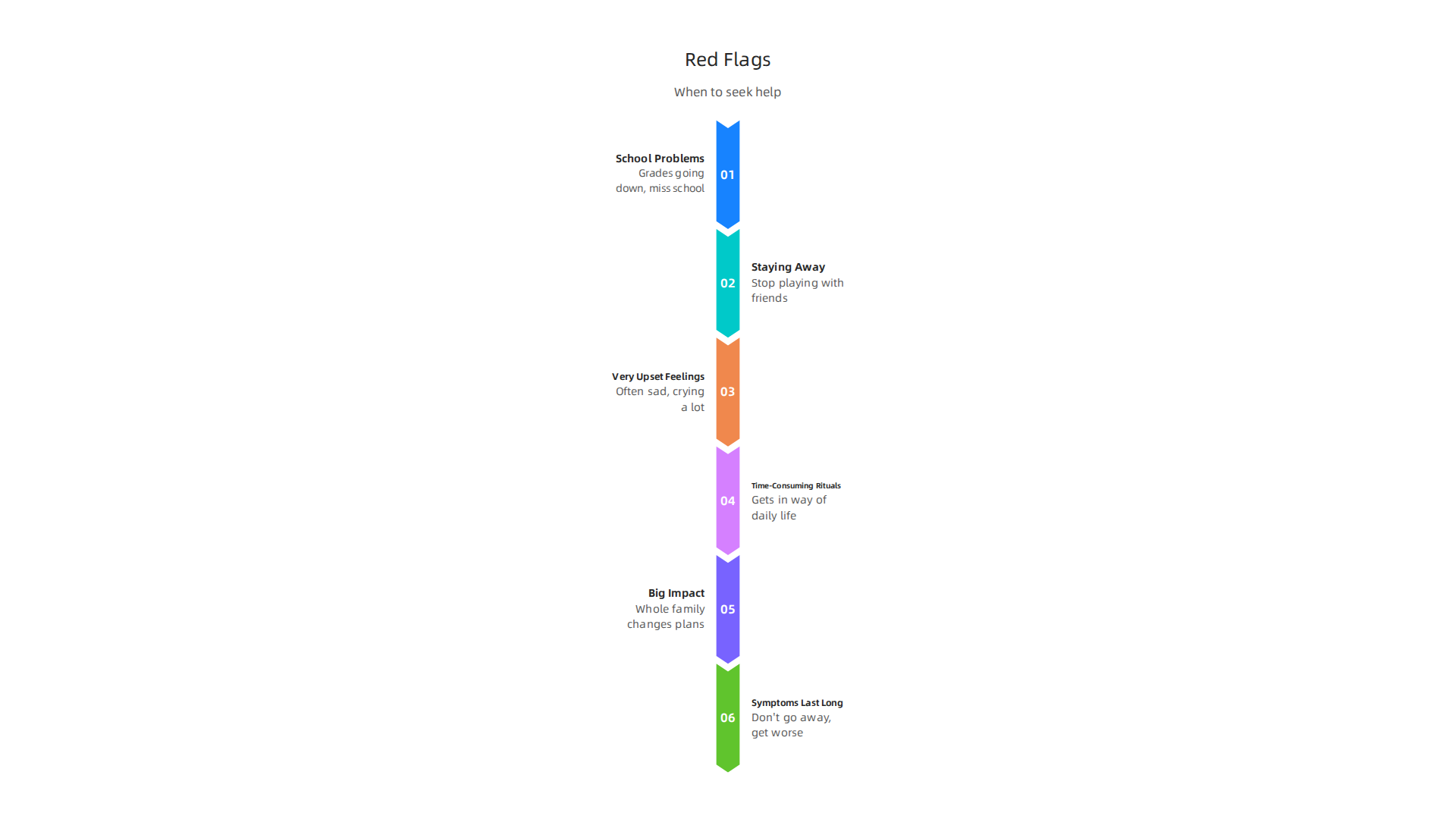
- School Problems: Their grades are going down, they miss a lot of school, or they can’t focus in class because of worries or urges.
- Staying Away from Others: They stop playing with friends, avoid family gatherings, or don’t want to go to parties or clubs they used to enjoy (social withdrawal).
- Very Upset Feelings: Your child is often sad, crying a lot, or showing big bursts of anger because of their anxiety or the need to do their rituals.
- Time-Consuming Rituals: Their compulsions take so much time that it gets in the way of school, sleep, or playing.
- Big Impact on Family Life: The whole family has to change plans or routines because of your child’s anxiety or OCD.
- Symptoms Last a Long Time: The signs you’re seeing don’t go away after a few weeks; they stay the same or get worse.
Noticing these signs is the first step toward getting your child the help they need for childhood anxiety and OCD. It’s important to remember you’re not alone in trying to understand these challenges. If you find yourself asking, "What is the pressure behind my child’s anxious feelings?", it’s a good time to explore what’s happening. You can learn more about finding ways to Decode Anxious Feelings and understand the hidden worries your child might be facing.
Knowing what to look for is a great start. The next step is understanding how to help your child find relief and begin [breaking free of child anxiety and OCD]. Luckily, there are proven ways to help children manage these big feelings and actions.
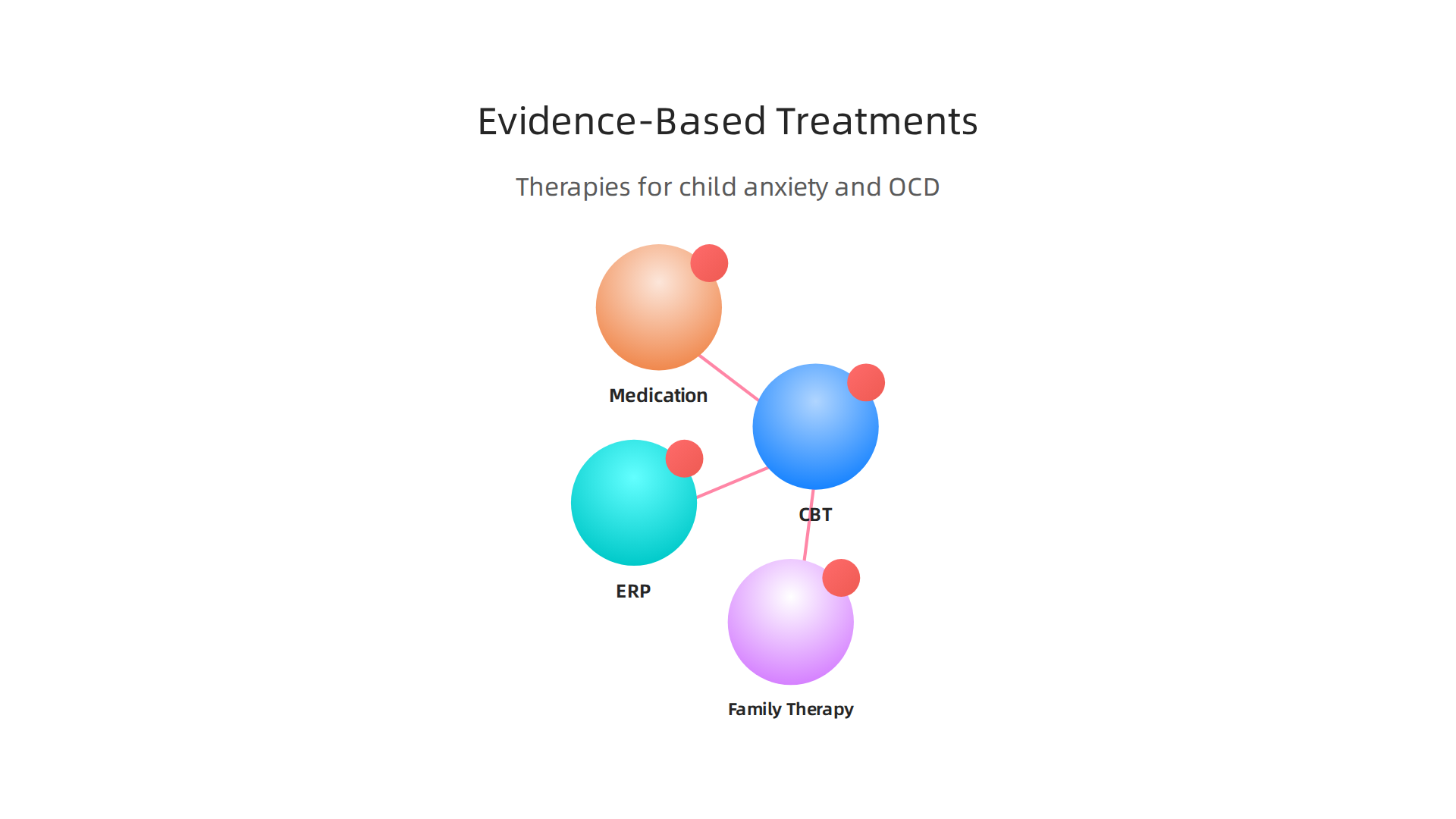
These treatments are often called "evidence-based," which means they have been studied a lot and are known to work well.
Cognitive Behavioral Therapy (CBT)
Cognitive Behavioral Therapy, or CBT, is a common and very helpful type of talk therapy. It helps children understand how their thoughts, feelings, and actions are all connected.
- How it Works: In CBT, children learn to spot anxious thoughts or thoughts that feed their OCD. Then, they learn ways to change those thoughts to be more helpful and less scary. They also learn new behaviors to replace old, unhelpful ones. For example, if a child always thinks "I’m going to fail this test," CBT helps them change that to "I can study hard and do my best." Research shows that CBT can be very effective for children, teenagers, and even adults who have anxiety or OCD, helping them reduce their symptoms significantly Adapted cognitive behavior therapy for obsessive compulsive ….
Exposure and Response Prevention (ERP)
ERP is a special kind of CBT that is known as the "gold standard" treatment for OCD. It’s often used for children with both childhood anxiety and OCD.
- How it Works: ERP helps children slowly and safely face the things that make them anxious or trigger their compulsions. The "response prevention" part means they learn to stop doing their usual rituals or compulsions. For example, if a child is afraid of germs and washes their hands many times, ERP might involve touching a "slightly dirty" surface and then waiting a short time before washing their hands. They learn that the scary thing doesn’t happen, and they can handle the uncomfortable feeling without doing their compulsion. This process helps them learn that their fears are often bigger than the actual danger. Experts agree that CBT with a focus on ERP is the best first psychological treatment for OCD in young people Obsessive–Compulsive Disorder in Children and Adolescents. You can learn more about how behavioral health centers use science-backed methods to treat anxiety and stress by visiting this helpful resource on behavioural health centers treat anxiety and stress with science-backed methods.
Medication
Sometimes, for more severe cases of childhood anxiety and OCD, or when therapy alone isn’t enough, doctors might suggest medication.
- How it Works: Medication, such as certain antidepressants, can help balance brain chemicals that are linked to anxiety and OCD symptoms. It’s important to know that medication for OCD, called ocd medication, is usually used along with therapy, not as the only treatment. A doctor will carefully decide if medication is right for your child, considering their age, symptoms, and other health factors. They will also keep a close eye on your child to make sure the medication is helping and not causing too many side effects.
Family Therapy and Parental Involvement
For children, getting better isn’t just about what happens in the therapist’s office. Family therapy and strong parental involvement play a huge role in [breaking free of child anxiety and OCD].
- How it Works: Parents learn how to support their child at home. This might mean learning how to respond to anxious behaviors or rituals in a way that helps, rather than accidentally making them worse. Parents are taught how to encourage their child to practice the skills they learn in therapy. This teamwork between the child, therapist, and family is very important for lasting change. When families work together, children have a much better chance of overcoming their challenges.
What to Expect from a Treatment Course
Starting treatment is a big step, and it’s good to know what lies ahead.
- It Takes Time and Effort: Treatment for childhood anxiety and OCD isn’t a quick fix. It takes time, patience, and consistent effort from everyone involved. Sessions are usually weekly, and the child will have "homework" to practice new skills between appointments.
- Ups and Downs: There will be good days and harder days. This is normal. The goal is to keep moving forward, even if it’s in small steps.
- Lasting Skills: The skills children learn in therapy are meant to last a lifetime. They help children not only manage their current anxiety or OCD but also cope with new challenges that come up as they grow.
- Positive Changes: As your child learns to manage their anxiety and OCD, you’ll likely see them become more confident, happier, and more engaged in daily life. This journey is about empowering your child to gain control and enjoy their childhood more fully.
The path to [breaking free of child anxiety and OCD] is a team effort, and with these evidence-based treatments, children can learn powerful strategies for a healthier future. Recognizing and rewarding healthy behaviors is a vital part of this process. In fact, the positive results of value reinforcement systems (VRS) in offsetting anxiety and mental health issues in youth have even been highlighted by Authority Magazine.
While professional therapy provides a strong foundation, there’s a lot you can do at home to help your child start feeling better right away. These practical steps give both parents and kids tools to manage anxious moments and work towards [breaking free of child anxiety and OCD].
Helping Your Child Find Calm: Parents’ Role
Parents are truly a child’s first teachers. You can learn simple ways to guide your child through tough feelings. Research even shows that training parents can be as helpful as therapy for reducing anxiety in children Parent Training as Effective for Childhood Anxiety as Therapy.
Here are some step-by-step techniques:
- Calming Scripts: When your child is anxious, try to stay calm yourself. Use simple, reassuring words. You can say something like, "I see you’re feeling scared right now, and that’s okay. We can handle this feeling together." Avoid saying, "Don’t be scared" or asking too many questions. Just be there and offer comfort.
- Gentle Exposure Steps (Scaffolding): This is about slowly helping your child face their fears, just like in ERP therapy, but in smaller, family-friendly ways. Think of it like building a tower one block at a time. If your child is afraid of dogs, start by looking at pictures of friendly dogs. Then, maybe watch a video. Later, stand far away from a real dog. This slow and steady approach helps them learn that fears can be managed. Experts often call this "scaffolding," where you provide just enough support for your child to succeed on their own Scaffold Parenting: Raising Resilient, Self-Reliant, and Secure Kids. You are empowering your child to face their fears, not avoid them. You can read more about how to do this in a helpful guide about Empowering Kids Through Exposures: A Parent’s Guide.
- Little Behavioral Experiments: Help your child test out their worried thoughts. If your child with
childhood anxiety and ocdthinks, "If I don’t check the lock ten times, something bad will happen," you can suggest checking it only once. Then, you observe together that nothing bad happened. This helps them see that their worries are not always true.
Quick Coping Tools for Kids
Children can also learn simple tricks to calm their bodies and minds when anxiety in 4 year olds or older kids shows up.
- Belly Breathing: Teach your child to breathe deeply from their belly, not their chest. Have them put a hand on their belly and pretend to be a balloon, filling up with air and slowly letting it out. This helps slow their heart rate and brings a sense of calm.
- Grounding Exercises: When feelings are big, kids can use their senses to feel "grounded" in the moment. Try the "5-4-3-2-1" game:
- Name 5 things you can see.
- Name 4 things you can touch.
- Name 3 things you can hear.
- Name 2 things you can smell.
- Name 1 thing you can taste.
This helps pull their mind away from anxious thoughts and back to the present. You can find more strategies for managing anxious moments in our guide on 10 Ways To Handle Anxiety Attacks And Regain Control Quickly.
- Exposure Games: Make facing fears a game! If your child is afraid of certain textures, play a game where they touch different fabrics for short times. If they fear certain noises, listen to quiet sounds and slowly increase the volume. The key is to make it fun and give them a sense of control.
Remember, practicing these tools often, even when your child isn’t anxious, makes them easier to use when they really need them. It’s all about building strength and confidence over time.
For an even deeper dive into how positive reinforcement systems can foster resilience in young individuals, check out our Youth Safety Case Study, documenting how VRS offsets susceptibility to manipulation in youth and helps in producing healthier athletes, stronger resistance to depression and propaganda, and ultimately better citizens.
Even with many helpful tools you can use at home, sometimes a child’s worries can become too big to handle alone. This is when thinking about professional help becomes important. It’s a brave step for families to seek extra support when they feel their child needs more help with breaking free of child anxiety and ocd.
When to seek professional help: assessments, referrals, and what to expect
Knowing when to seek help is key. You might consider professional support if:
- Worries are very strong: Your child’s anxiety or OCD symptoms are very intense and happen often.
- Life is getting harder: The anxiety makes it hard for your child to go to school, play with friends, or enjoy family activities. For example, if
anxiety in 4 year oldsmakes everyday tasks a huge struggle. - Home strategies aren’t enough: The ideas you’ve tried at home, like belly breathing or gentle exposures, aren’t making a big enough difference.
- Symptoms are getting worse: Your child’s worries or rituals are increasing over time.
It’s important to remember that asking for help is a sign of strength, not weakness.

Many families face these challenges, and there are good people ready to help. Sadly, there can be barriers to care, like not enough services or worries about what others might think The Youth Mental Health Imperative. But your child’s well-being is what matters most.
Who can help your child?
You usually start by talking to your child’s doctor, like a pediatrician. They can check if there are any physical health reasons for the symptoms. If not, they can often suggest special doctors or therapists.
- Child Psychologists or Therapists: These experts are trained to help children with their thoughts and feelings. They often use a type of talk therapy called Cognitive Behavioral Therapy (CBT), especially one part called Exposure and Response Prevention (ERP). ERP is a very effective way to treat
childhood anxiety and ocd. Experts say that CBT with ERP is the main treatment for OCD in kids and teens Obsessive–Compulsive Disorder in Children and Adolescents. It teaches kids how to face their fears little by little without doing their usual rituals. You can learn more about finding the right support when you need help managing strong feelings by reading about when to seek stress management therapy and what to expect. - Child Psychiatrists: These are medical doctors who specialize in mental health for children. They can also do assessments and offer therapy. Sometimes, they might suggest
ocd medicationif the anxiety or OCD is very severe and other treatments haven’t worked enough. This is usually done alongside therapy, not by itself.
What to expect during assessments
When you first see a professional, they will want to learn all about your child’s experiences. This usually includes:
- Talking with you: The expert will ask you many questions about your child’s worries, when they started, what makes them better or worse, and how they affect daily life.
- Talking with your child: They will also chat with your child in a way that is easy for them to understand, to hear about their feelings from their own perspective.
- Questionnaires: You and your child might fill out some forms that help the expert understand the symptoms better.
- School information: Sometimes, with your permission, the expert might ask for input from your child’s school about how they are doing there.
It’s very helpful to bring any notes you have about your child’s symptoms, important dates, or anything else you think is important. This helps the professional get a full picture.
Support in school
If your child’s anxiety or OCD affects their learning at school, they might be able to get special support. This could include a "504 Plan," which provides reasonable changes or accommodations to help them succeed in the classroom Section 504 Protections for Students with Anxiety Disorders. These plans can offer things like extra time on tests, a quiet space, or a trusted adult to talk to.
Learning about these options is part of empowering your family. For more help with understanding and overcoming anxious feelings, you can decode anxious feelings and build inner strength with practical coping strategies on our platform.
While professional help is a powerful step, many daily actions at home and school also play a big role in helping children. Creating a supportive environment can make a huge difference for kids who are learning about breaking free of child anxiety and ocd.
Creating a supportive home and school environment: prevention and day-to-day supports
At home, you can create a calm and predictable space. Children thrive on routine, so having clear schedules for waking up, meals, homework, and bedtime can help them feel safe and in control. This is especially helpful for young children, like those with anxiety in 4 year olds, who need consistency to feel secure.
It’s also important to talk openly about feelings. Help your child find words for what they are feeling. Listen to their worries without making them feel silly. How parents respond can greatly influence how a child manages their anxiety. Research shows that teaching parents how to react to a child’s behaviors can be just as good as therapy for easing anxiety Parent Training as Effective for Childhood Anxiety as Therapy. This means parents can learn to gently encourage their kids to face their fears, which is a key part of therapy. Think of it like giving your child just enough support to grow stronger, a method sometimes called "scaffold parenting" Scaffold Parenting: Raising Resilient, Self-Reliant, and Secure Kids. For more ideas on how to manage everyday worries, you can explore Anxiety Management Step-by-Step Strategies That Really Work.
Working with schools for success
Schools are a big part of a child’s life, and they can be a great partner in helping with childhood anxiety and ocd. Start by talking to your child’s teacher or school counselor. Share what your child is going through and what helps them at home. Many teachers are happy to make small changes in the classroom. These might include:
- Giving your child a quiet corner to work in when they feel stressed.
- Allowing extra time for tests or assignments.
- Letting your child take short breaks if they feel overwhelmed.
- Having a trusted adult at school your child can talk to.
For children with more serious needs, formal plans can be put in place. As mentioned before, a 504 Plan helps by providing reasonable changes or "accommodations" to the school setting. If a child needs more specialized teaching or services because of their anxiety or OCD, an Individualized Education Program (IEP) might be more suitable. Both 504 and IEP plans are important tools to ensure students get the help they need to succeed in school and feel supported Child / Adolescent Mental Health – Project TEACH. Remember, working closely with the school team ensures your child has a consistent support system both at home and in the classroom.
Summary
This article explains how childhood anxiety and obsessive–compulsive disorder (OCD) differ, why that difference matters, and how parents can identify and respond to each. It defines obsessions and compulsions versus common worries, lists typical signs for both conditions, and highlights red flags that suggest professional help is needed. The guide outlines evidence-based treatments — especially CBT with Exposure and Response Prevention (ERP) — and describes when medication may be added. It also shows practical steps parents can use at home (calming scripts, gentle exposures, grounding, belly breathing) and how to work with schools for accommodations like 504 plans or IEPs. Readers will learn what to expect from assessments, how family involvement supports recovery, and clear next steps for getting help so children can regain confidence and daily functioning.