
Introduction: When Your Mind and Body Need Calm Fast
Picture this: Your heart starts pounding. Your chest feels tight. You can’t catch your breath. An anxiety attack can hit out of nowhere, leaving you scared and unsure what to do next.
Maybe it happens during a work meeting, in the middle of the night, or while you’re stuck in traffic. The feeling is overwhelming. But here’s the good news. There are proven ways to handle anxiety attacks and regain control quickly.
You are not alone in this. According to the National Institute of Mental Health, an estimated 19.1% of U.S. adults experienced any anxiety disorder in the past year, with higher rates among women. The Anxiety and Depression Association of America adds that generalized anxiety disorder affects 6.8 million adults, yet only 43.2% are receiving treatment. These numbers tell us that anxiety is widespread, and many people are still looking for practical help.
This article presents 10 actionable methods grounded in research and clinical practice. They are ranked by speed and ease of use. So whether you are dealing with a night time anxiety attack or looking for how to get over a panic attack fast, you will find real strategies here. We focus on immediate relief techniques you can use anytime, anywhere, without any special equipment.
We also cover what comes after the attack. Because post stress symptoms can linger, and knowing how to calm your body down matters just as much as stopping the initial panic.
If you want to go deeper into understanding what triggers your anxiety, explore our practical guides and simple exercises to better understand and manage your anxiety.
1. Deep Breathing: The 4-7-8 Technique
Let’s start with the fastest tool you have. When a panic attack hits, your breathing gets shallow and fast. This makes your body think danger is everywhere. The 4-7-8 technique stops that cycle in its tracks.
This breathing pattern talks directly to your nervous system. It tells your body, "You are safe now." Experts at the Cleveland Clinic say that 4-7-8 breathing can help you tap into your inner calm and benefit your stressed-out nervous system. Research covered by Healthline also found that this technique can reduce symptoms of anxiety.
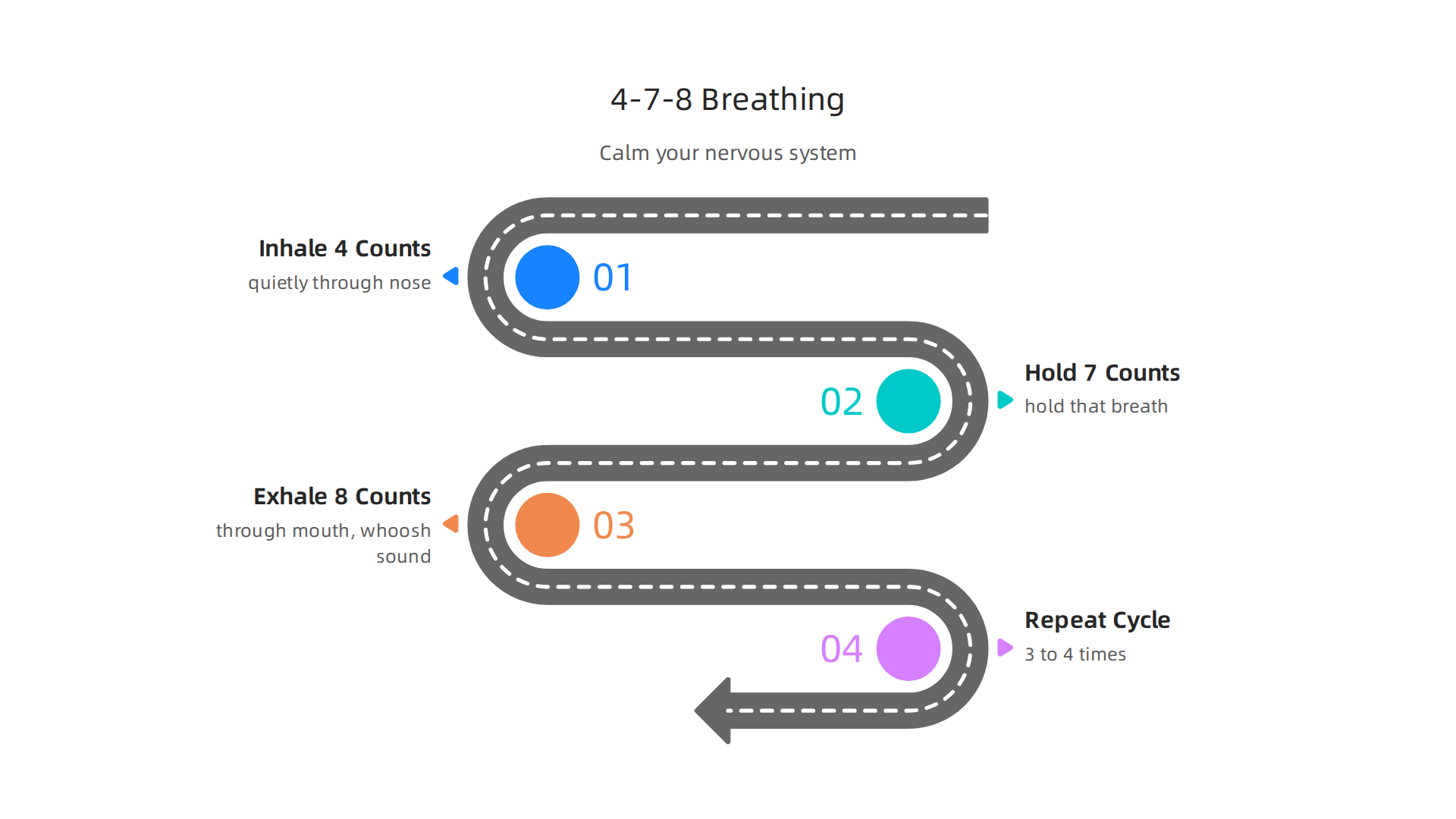
Here is how you do it. You can do this sitting up or lying down.
It works great for a night time anxiety attack when you are trying to fall asleep.
- Let your lips part gently.
- Breathe in quietly through your nose for a count of 4 seconds.
- Hold that breath for a count of 7 seconds.
- Breathe out completely through your mouth for a count of 8 seconds. Make a soft "whoosh" sound.
- Repeat this cycle 3 to 4 times.
That is it. It works because the long exhale activates your body’s relaxation response. It is one of the best ways to handle anxiety attacks because you can use it anytime, anywhere, and no one has to know.
It also helps with the post stress symptoms that linger after the main panic fades. WebMD notes that disrupting the stress response this way can help lower your blood pressure and improve your sleep over time.
If you want to pair this with other proven coping tools, explore practical guides and simple exercises to better understand and manage your anxiety.
2. Grounding: The 5-4-3-2-1 Technique
Deep breathing works from the inside out. But sometimes your thoughts are racing so fast that you cannot focus on counting. That is where grounding comes in.
Grounding pulls your attention away from what is happening inside your body and puts it on the world around you. It is one of the smartest ways to handle anxiety attacks because it breaks the panic spiral before it gets worse. Clinicians often suggest this as a first tool for panic relief.
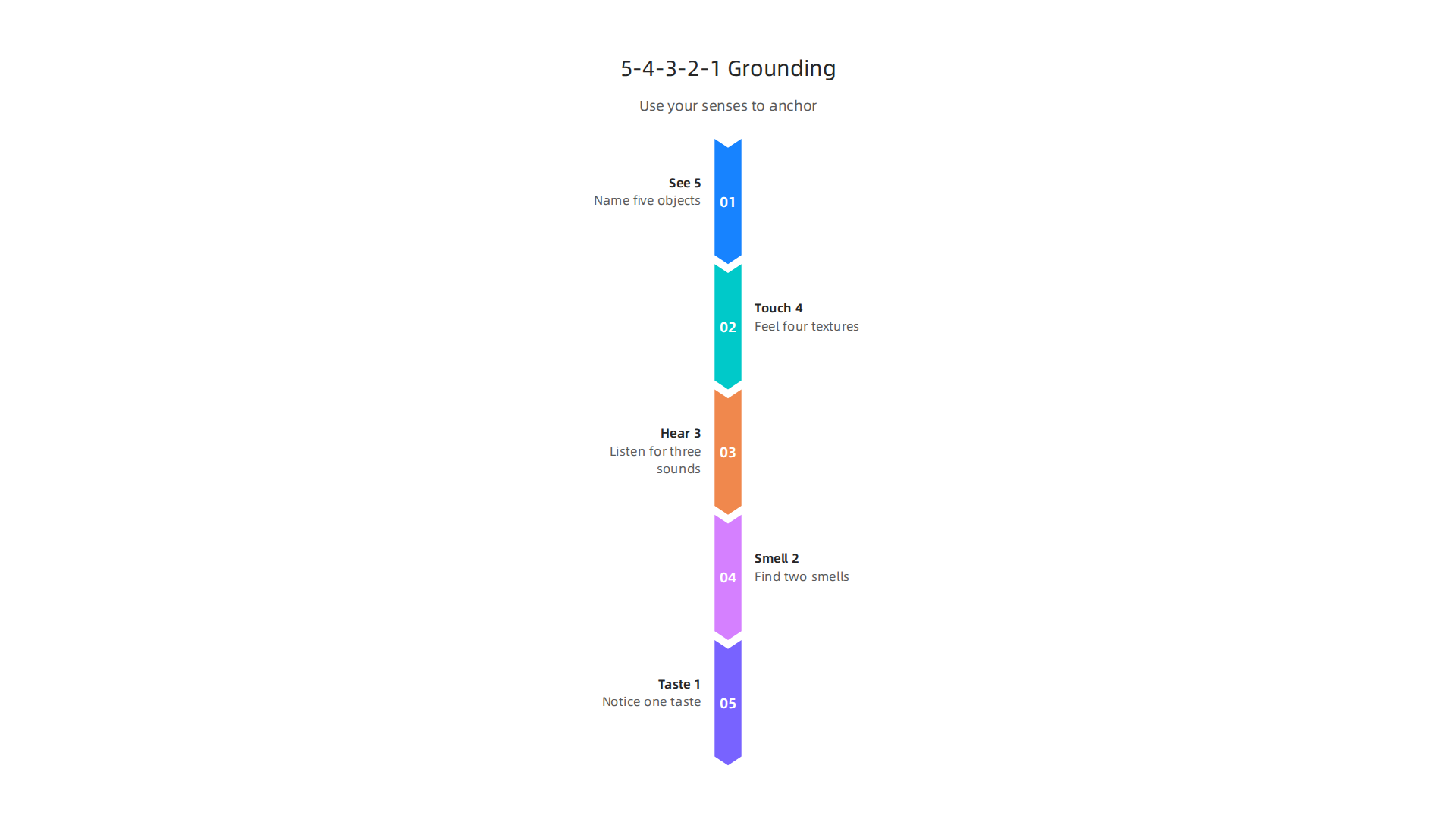
The 5-4-3-2-1 method uses your five senses to anchor you in the present moment.
You can do this anywhere, even during a night time anxiety attack when you are lying in bed. Here is how it works:
- 5 things you can SEE. Look around and name five objects. A lamp. A water bottle. A crack in the ceiling. The color of your blanket. The edge of a door.
- 4 things you can TOUCH. Feel four textures. The fabric of your shirt. The cool wall. A wooden table. Your own hair.
- 3 things you can HEAR. Listen for three sounds. A distant car. A fan humming. Your own breath.
- 2 things you can SMELL. Find two smells. The air after rain. Your morning coffee. The scent of a candle.
- 1 thing you can TASTE. Notice one taste. The leftover flavor from your last drink. A mint on your tongue.
This exercise forces your brain to process real information instead of fake danger signals. It helps with the post stress symptoms that linger after panic fades.
If you want to learn more about what happens in your body during a panic episode and how to spot the early signs, check out this guide on panic attack symptoms based on DSM-5 criteria.
Give the 5-4-3-2-1 method a try next time you feel that familiar wave rising. And if you want more simple tools like this one, Explore Guides on managing anxiety with step-by-step strategies that really work.
3. Cognitive Reframing: The STOP Acronym
Grounding pulls you back to the present moment. But once you are calm, your brain may still try to convince you that something terrible is about to happen. That is where cognitive reframing comes in.
Cognitive reframing is a way to challenge those scary, automatic thoughts that fuel anxiety. Instead of letting your mind spiral, you interrupt the pattern and look at the situation from a more realistic angle. Therapists often use this to help people change how they see stressful events, and research shows it is one of the strongest ways to handle anxiety attacks.
A simple tool to practice cognitive reframing is the STOP acronym.
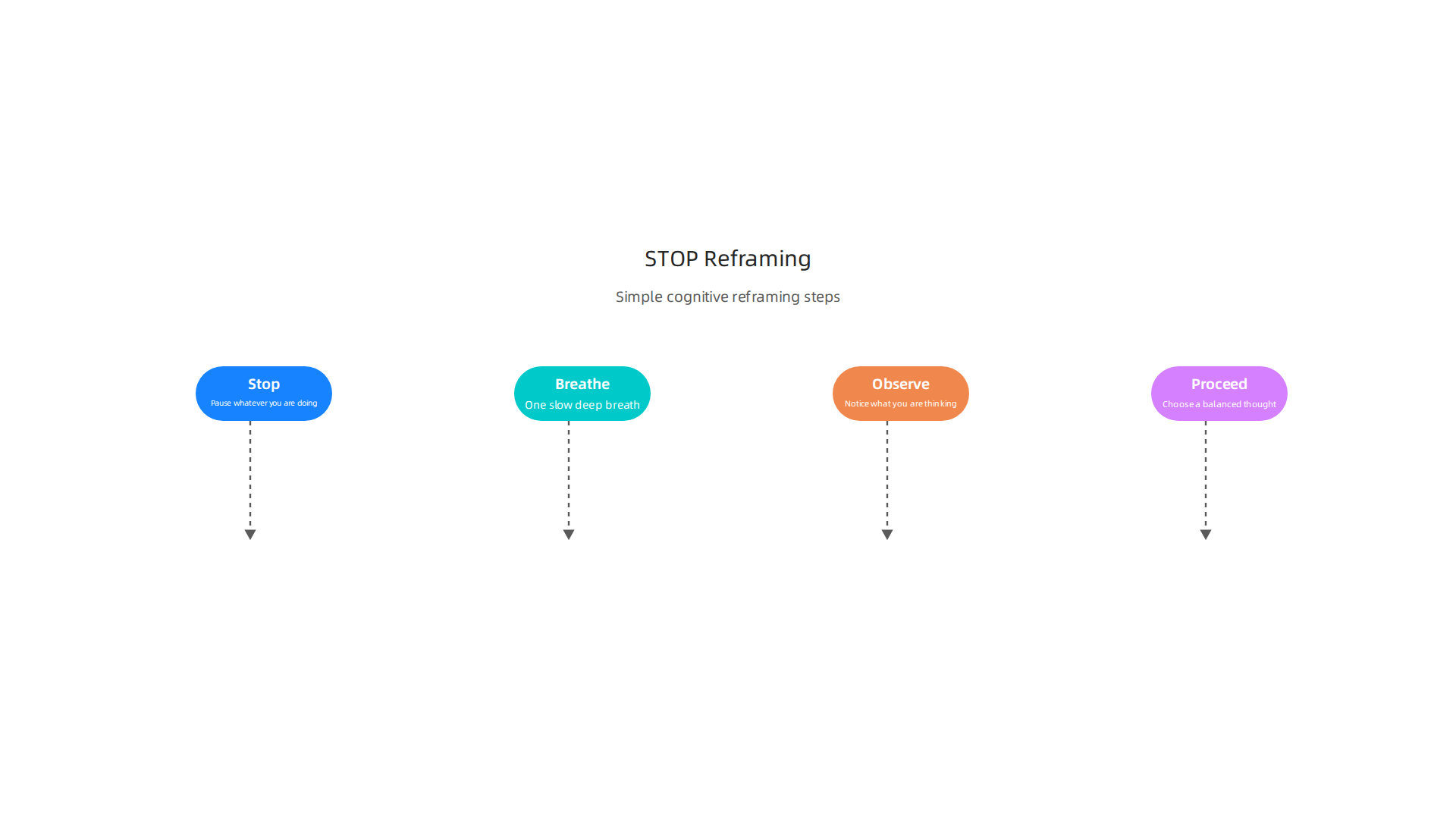
It is easy to remember, and it works even during a night time anxiety attack.
- S – Stop. When a scary thought appears, pause whatever you are doing. Do not follow the thought.
- T – Take a breath. Take one slow, deep breath. This signals your body that you are safe.
- O – Observe. Notice what you are thinking and feeling. Are your thoughts 100% facts or are they guesses? The NHS recommends taking a step back to look at the evidence behind unhelpful thoughts.
- P – Proceed. Choose a more balanced thought to move forward with. For example, “I feel anxious, but I have handled this before.”
This method combines mindfulness with cognitive restructuring. It helps you stop fighting your feelings and start questioning them instead. After a panic episode, STOP can also ease the post stress symptoms that linger.
If you want to see the full list of ways to handle anxiety attacks and understand what happens during a panic episode, check out this detailed guide on panic attack symptoms.
For a deeper dive into simple, science-backed techniques like this one, Explore Guides that walk you through step-by-step exercises to manage your anxiety.
4. Distraction: Mental Math and Color Naming
The STOP method helps you question scary thoughts. But sometimes your brain just needs a break. That is where distraction techniques come in.
Distraction works by taking up space in your working memory. When your brain is busy with a simple task, it has less room for anxious thoughts.
This is one of the most useful ways to handle anxiety attacks because it works fast and does not require much effort.
Here are two simple tasks you can try right now:
- Mental math. Try counting backward from 100 by 7s. Go like this: 100, 93, 86, 79, 72. It takes just enough focus to pull your mind away from panic. You can also try subtracting by 3s or 9s.
- Color naming. Look around the room and find five things that are blue. Then find five green things. Then yellow. Keep going. This forces your attention outward instead of inward.
Both methods are easy to remember and do not need any tools. They work great for a night time anxiety attack when you are lying in bed with your thoughts spiraling. The low cognitive load makes them accessible even during high arousal.
These techniques are part of a larger approach called cognitive behavioral therapy, which research shows is very effective for anxiety. Using simple tasks like this can also help ease post stress symptoms after a panic episode passes.
For more science-backed ways to manage anxious moments, check out the research on CBT for anxiety.
If you want to add more practical exercises to your daily routine, Explore Guides that walk you through step-by-step techniques to feel calmer.
5. Progressive Muscle Relaxation (PMR)
The mental exercises we just covered help shift your focus. But anxiety does not just live in your head. It shows up as tight shoulders, a clenched jaw, and a knot in your stomach.
Progressive Muscle Relaxation (PMR) directly targets this physical tension. It is a simple technique where you tense a muscle group for a few seconds and then let go completely. This contrast pushes your body out of "fight or flight" mode and into a state of low arousal.
PMR is widely taught in anxiety therapy. Research from 2024 confirms that PMR is effective for reducing stress, anxiety, and depression in adults. The Cleveland Clinic also notes that it helps control the anxiety response and relaxes you for better sleep.
You can do a full body scan in 5 to 10 minutes. Start with your feet. Tense them hard for 5 seconds. Release and feel the warmth spread. Then move to your calves, thighs, stomach, hands, arms, shoulders, and face.
This is one of the best ways to handle anxiety attacks when you feel the physical rush. If you wake up having an anxiety attack in the night, PMR gives you a body-based anchor to compete with the panic. Afterward, it helps ease those lingering post stress symptoms.
If you want more structured exercises to build into your routine, check out these step-by-step strategies for anxiety.
Learning to listen to your body is a powerful skill. Explore Guides for more simple exercises to build calm.
6. Physical Movement: Walking or Shaking
Progressive Muscle Relaxation works well for settling tight muscles. But sometimes your anxiety feels more like a jolt of restless energy. You might feel the urge to pace, fidget, or run. That is your body flooding with stress hormones like adrenaline and cortisol. The best way to burn those off is through movement.
Even a short burst of moderate physical activity can reset your nervous system.

You do not need a full workout. Just two to three minutes of brisk walking around your room or shaking out your arms and legs can make a big difference. This is one of the simplest ways to handle anxiety attacks when the energy feels stuck in your body.
For a night time anxiety attack, try getting up and walking a few steps. Shake your hands and feet gently. The movement signals to your brain that the danger has passed. It helps lower those post stress symptoms faster than staying still.
Walking also gives your mind a break. Focusing on each step pulls your attention away from the anxious thoughts. If you want more step-by-step techniques to manage these moments, check out this guide on anxiety management strategies that really work.
The key is to move without forcing yourself to calm down. Let the body do its job. Once the rush fades, you can return to a seated position and use breathing or PMR if needed. Simple movement is a powerful tool.
Explore Guides for more practical exercises to build calm at your own pace.
7. Sensory Grounding: Temperature and Texture
Movement helps burn off the restless energy, but what if you need a faster way to snap your brain out of the panic loop? That is where sensory grounding comes in. Using intense sensations like cold water or a textured object can rapidly pull your focus away from the racing thoughts and back into the present moment. It is one of the most effective ways to handle anxiety attacks when your mind is spinning out of control.
Here is the science. Splashing cold water on your face triggers what is called the mammalian dive reflex. This activates your vagus nerve, which helps slow your heart rate and calm your nervous system within seconds. You can also try holding an ice cube in your hand or pressing a cold drink can against your wrist or neck for about 30 seconds. The intense cold overrides the panic signals and gives you a reset.
If you are dealing with a night time anxiety attack, this technique works especially well because you can do it quietly in the bathroom or kitchen. Fill a bowl with cold water (add ice if you have it) and immerse your face or hands for 15 to 30 seconds. Focus completely on the sensation of cold. It can help lower those post stress symptoms faster than lying in bed trying to think your way out of it.
Texture works too. Rubbing a rough fabric, a metal railing, or even a piece of fruit can ground you. The key is to focus intensely on how it feels.
For more step-by-step strategies like this, check out our guide on anxiety management strategies that really work.
Sensory grounding is simple, fast, and you can do it almost anywhere. Give it a try next time the panic starts building. Then explore more practical exercises and guides to build your calm at your own pace.
8. Environmental Change: Step Out or Shift Scenery
Sensory grounding works by changing what your body feels. But what if changing where you are works even faster? Sometimes the best way to handle an anxiety attack is to leave the space where it started.
Your brain links feelings to places. If you had an anxiety attack in your living room, that room can become a trigger. By stepping outside or into a different room, you break that cycle. You give your brain new signals to process. Research suggests that stepping outside into different weather can provide immediate relief.
This is a powerful way to get over a panic attack. Even small changes matter. Open a window for fresh air. Move from your bedroom to the kitchen. If you are having a night time anxiety attack, walking to a well-lit living room or even just onto a balcony can help. The change in temperature, light, and space forces your mind to reset.
This technique combines mild movement with sensory novelty. It works well for post stress symptoms, too. You are telling your brain, "I am safe here now." It is one of the simplest ways to handle anxiety attacks because it requires no tools or apps.
For a deeper look at how your environment shapes your mood, you can explore this guide on generalized anxiety disorder diagnosis and treatment strategies, which explains how triggers form in the first place.
Once you step away from the triggering space, Behavioral Scientist Dean Grey offers a research-backed lens for understanding how outside pressure affects self-trust. Explore practical guides and simple exercises to better understand and manage your anxiety.
9. Lifestyle Adjustments for Prevention
Stepping away from a triggering space helps you right now. But the best ways to handle anxiety attacks also include preventing them from starting in the first place. Small daily habits can lower your stress baseline. This makes attacks less frequent and less intense.
Start with the basics. Get regular sleep. Drink enough water. Cut back on caffeine. These things might sound simple, but they are powerful. Research shows that healthy lifestyle behaviors promote mental health and can help prevent mental health conditions. When your body is well rested and hydrated, your nervous system stays calmer.
If you struggle with a night time anxiety attack, poor sleep habits are often a hidden cause. A study on lifestyle modification points out that routine, time management, and basic daily activities are key. You do not need a perfect schedule. You just need consistency.
Here is the thing. Lifestyle adjustments are not an immediate fix. They will not stop an attack that has already started. But they lower the chance that you will have an anxiety attack in the first place. Think of them as your long term defense. To understand how outside pressure affects your self trust, Behavioral Scientist Dean Grey offers a helpful research lens for these patterns.
Another part of prevention is learning your early warning signs. Maybe your jaw clenches. Maybe your breathing gets shallow. Recognizing these signals early gives you a chance to intervene before things get worse. You can use grounding techniques or breathing exercises before the attack takes over. To learn more about spotting these signs, check out this panic attack symptoms self assessment checklist.
For more daily strategies, read our guide on anxiety management step by step strategies that really work. It walks you through building a routine that fits your life.
If you are ready to take control of your anxiety, explore practical guides and simple exercises to better understand and manage your anxious feelings.
10. When to Seek Professional Help
All the self-help techniques in the world are valuable. They can teach you many ways to handle anxiety attacks and help you feel more in control. But there comes a point when these tools are not enough on their own.
That is okay. It does not mean you failed.
Some red flags tell you it is time to talk to a professional.
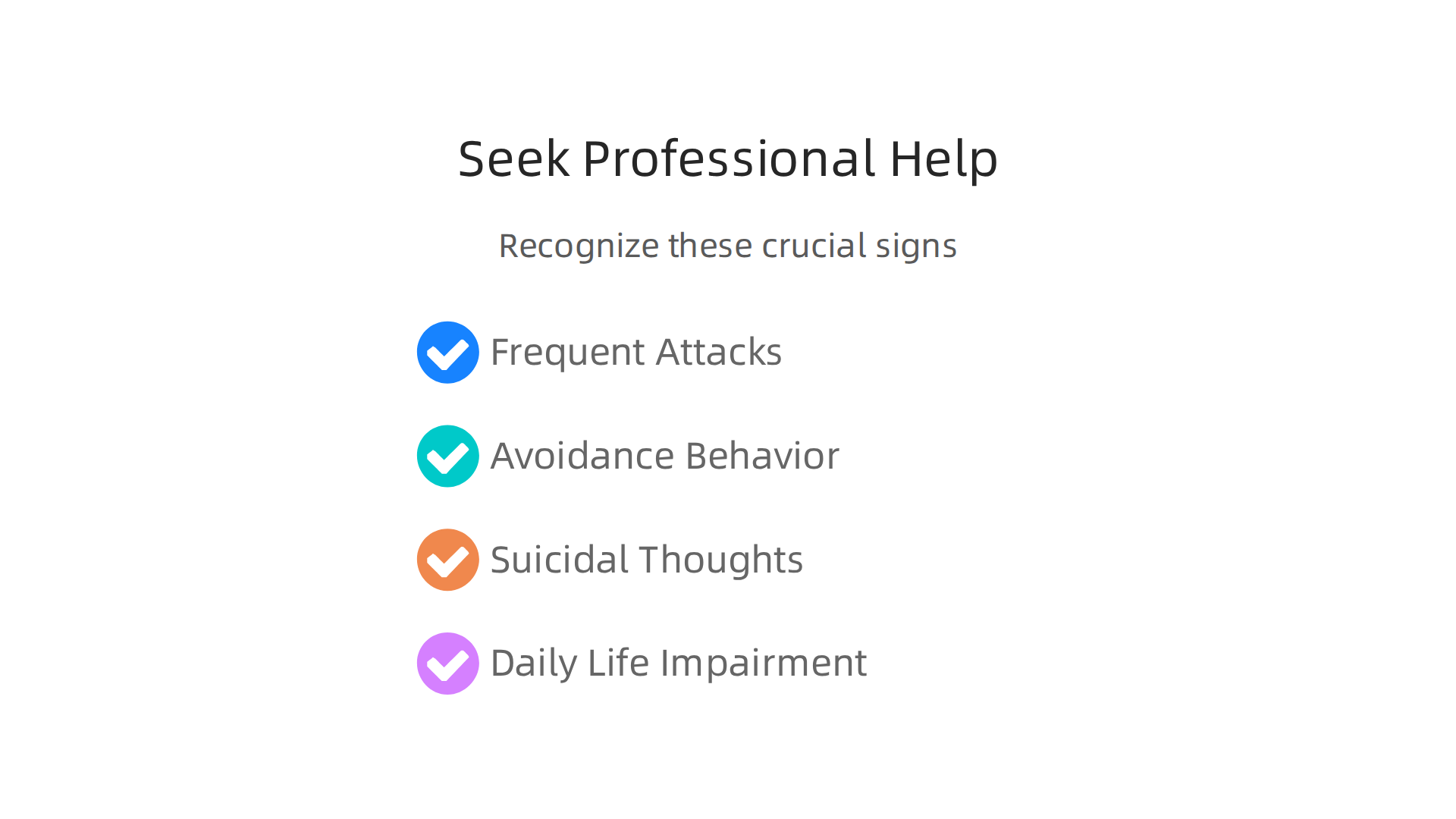
Watch for these signs:
- Frequent attacks. If you get panic attacks several times a week or every single day, that is a strong signal.
- Avoidance behavior. You start skipping social events, work, or even leaving your house because you fear an attack.
- Suicidal thoughts. Any thought of harming yourself needs immediate attention.
- Daily life impairment. Your anxiety stops you from doing basic things like grocery shopping, sleeping, or holding a conversation.
If any of these sound familiar, do not try to handle it alone. The two main treatments for anxiety disorders are psychotherapy and medications. Many people benefit most from a mix of both.
Professional treatment can also help if you struggle with an anxiety attack in night that keeps you from sleeping. A therapist will teach you targeted strategies that go beyond general advice. They might recommend creating a personalized safety plan you can use during an episode.
To start, talk to your primary care doctor. They can refer you to a specialist. You can also use our guide to find a therapist for breakup recovery and heal from anxiety if relationship stress is part of the picture.
Taking this step is not a sign of weakness. It is one of the smartest ways to handle anxiety attacks for good. If you are ready to learn more about your options, explore practical guides and simple exercises to understand what treatment might look like for you.
Summary
This article explains ten practical, research-backed techniques to stop an anxiety or panic attack quickly and safely, ranked by speed and ease of use. It covers immediate tools you can use anywhere—like the 4-7-8 breathing method, the 5-4-3-2-1 grounding exercise, sensory grounding with cold water, progressive muscle relaxation, brief movement, and quick mental distractions—plus cognitive reframing to change unhelpful thoughts. The piece also explains how to recover after an episode, reduce post-stress symptoms, and lower future risk through simple daily habits such as sleep, hydration, and reduced caffeine. You’ll learn exactly how to perform each technique, when to try which tool (including nighttime options), and when to seek professional care. The goal is to give readers fast, usable strategies that restore control in the moment and practical steps to prevent attacks over time.