

Making the Hard Decision: When Anxiety Requires Inpatient Care
Anxiety disorders are incredibly common. In fact, they affect more than 40 million adults in the United States every year according to the latest Mental Health By the Numbers report from NAMI. That is roughly 1 in 5 adults. For many people, anxious feelings show up as daily worry, racing thoughts, or a tight chest during stressful moments. The good news is that most of these cases can be managed with outpatient support. Things like seeing a therapist weekly, practicing mindfulness, or making small lifestyle changes often make a big difference.
But sometimes anxiety stops being manageable. It becomes severe. It might keep you from leaving the house, holding a job, or even sleeping. When symptoms reach this level, a higher level of care may be necessary. That is where inpatient mental health treatment comes in. Inpatient care provides round the clock support in a safe, structured environment. It is not something to fear. It is a tool designed to help people stabilize and recover when outpatient options are not enough.
This article is here to help you identify the threshold where inpatient care becomes the right next step. We will walk through the signs that suggest you or a loved one might need more than weekly therapy. We will also explain what to expect during a stay and how to find affordable options, including therapy near me that takes medicaid or a psychiatrist that takes medicaid near me. You do not have to face this decision alone.
If you are feeling overwhelmed right now and unsure what to do next, start by naming what is going on inside.

Decode Anxious Feelings with a simple strategy that helps you understand the pressure behind the feeling. Then keep reading to learn when inpatient care might be the right call.
Understanding Inpatient Mental Health Treatment
So what exactly is inpatient mental health treatment? Let’s break it down in simple terms.
Think of mental health care like a ladder. On the bottom rung, you have weekly therapy sessions or phone check ins with a counselor. On the top rung, you have inpatient care. Inpatient mental health treatment means you stay overnight in a hospital or specialized facility where doctors, nurses, and therapists are available 24 hours a day, 7 days a week. You are not alone at any moment.
The main goal is safety and stabilization. When your anxiety gets so bad that you cannot eat, sleep, or even get out of bed, your brain needs a reset. Inpatient care provides that reset in a calm, supervised space. You are removed from the stressful triggers of daily life, and you get intensive support from a team of professionals.
This level of care is very different from outpatient therapy. In outpatient therapy, you go to a therapist’s office for one hour each week, then go home. It works well for mild to moderate anxiety. But when symptoms become severe, one hour a week is simply not enough.
There are also middle steps. Intensive outpatient programs (IOPs) require several hours of therapy each day but let you sleep at home. Partial hospitalization programs (PHPs) feel like a full day of treatment, but again, you go home at night. These options sit between outpatient and inpatient care.
But inpatient care is the highest level. According to a guide on mental health levels of care published by the Anxiety and Depression Association of America, the term "level of care" describes the range of psychiatric services that vary in frequency, intensity, and duration. Inpatient is the most intense option.
Inpatient programs are designed for acute crises. That means situations where someone might harm themselves or others, or where their ability to function is completely gone. For example, if panic attacks happen multiple times a day and you cannot leave your home, that qualifies. If you stop eating or washing because your anxiety is too loud, that qualifies too.
One important thing to know: inpatient care is not a punishment. It is not a locked ward from a scary movie. In 2026, most facilities are calm, clean, and focused on healing. You will have a private or semi private room, group therapy, one on one counseling, and medication management if needed.
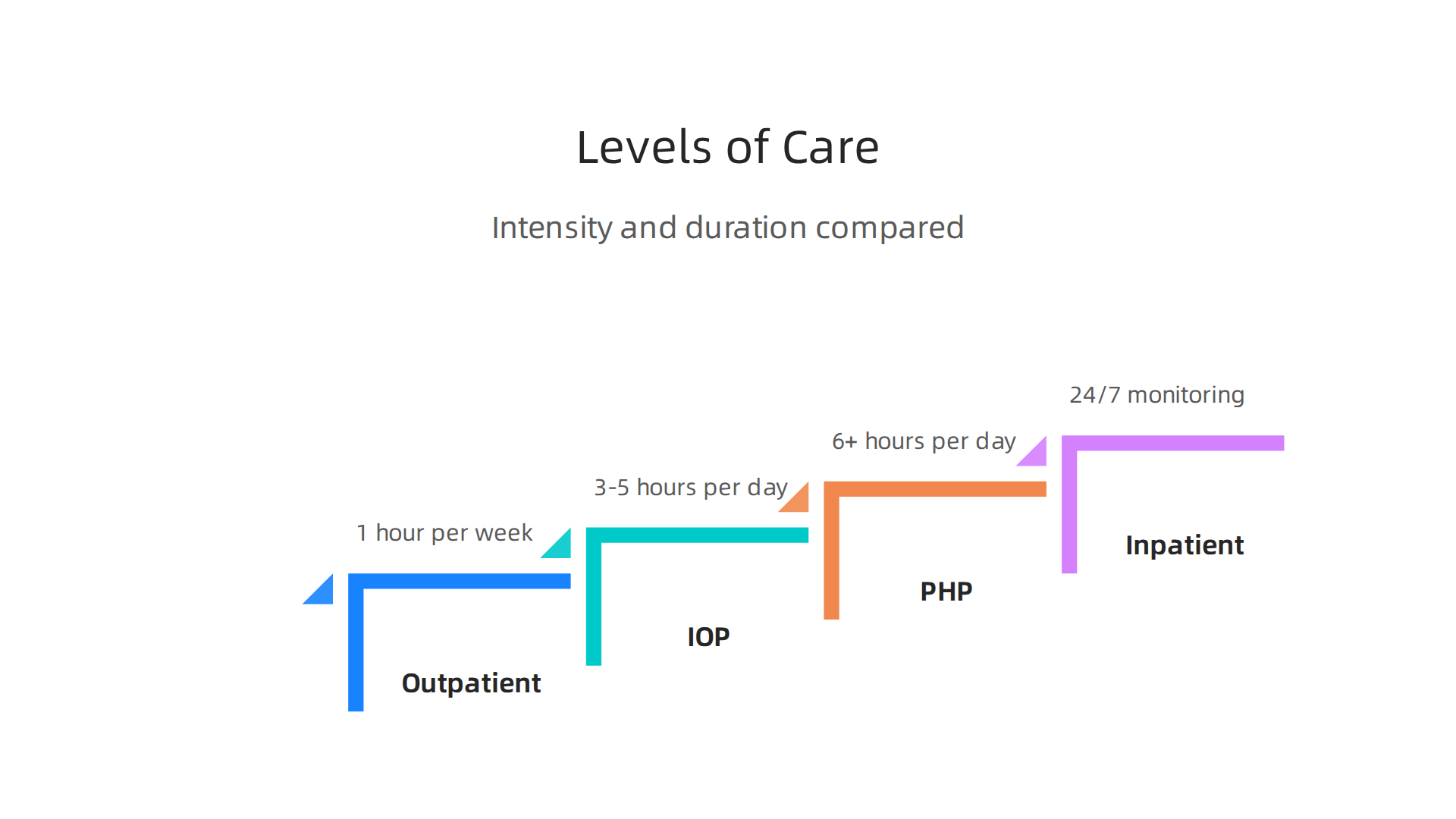
To give you a clearer picture, here is how the levels of care compare:
| Level of Care | Where you sleep | Hours of support | Best for |
|---|---|---|---|
| Outpatient therapy | At home | 1 hour per week | Mild to moderate anxiety |
| Intensive Outpatient (IOP) | At home | 3-5 hours per day, 3-5 days per week | Moderate to severe anxiety |
| Partial Hospitalization (PHP) | At home | 6+ hours per day, 5 days per week | Severe anxiety needing structure |
| Inpatient | At the facility | 24/7 monitoring | Crisis, risk of harm, no functioning |
Another great resource from Rogers Behavioral Health explains the different levels of care including inpatient, residential, PHP, and IOP. It helps to see the whole picture.
If you are still unsure whether inpatient care fits your situation, a good next step is to learn more about common anxiety symptoms so you can recognize what is happening. Understanding your own panic attack vs anxiety attack differences can help you decide how serious things really are.
The bottom line? Inpatient mental health treatment is a powerful tool for the hardest moments. It exists to help you get stable when everything else has failed. And there is no shame in using it.
Signs That Outpatient Care Isn’t Enough
So you have been trying therapy. Maybe you see a therapist every week. You do the breathing exercises. You try to avoid triggers. But things are still getting worse. How do you know when weekly sessions are no longer enough?
Here are the clearest signs that you need a higher level of help.
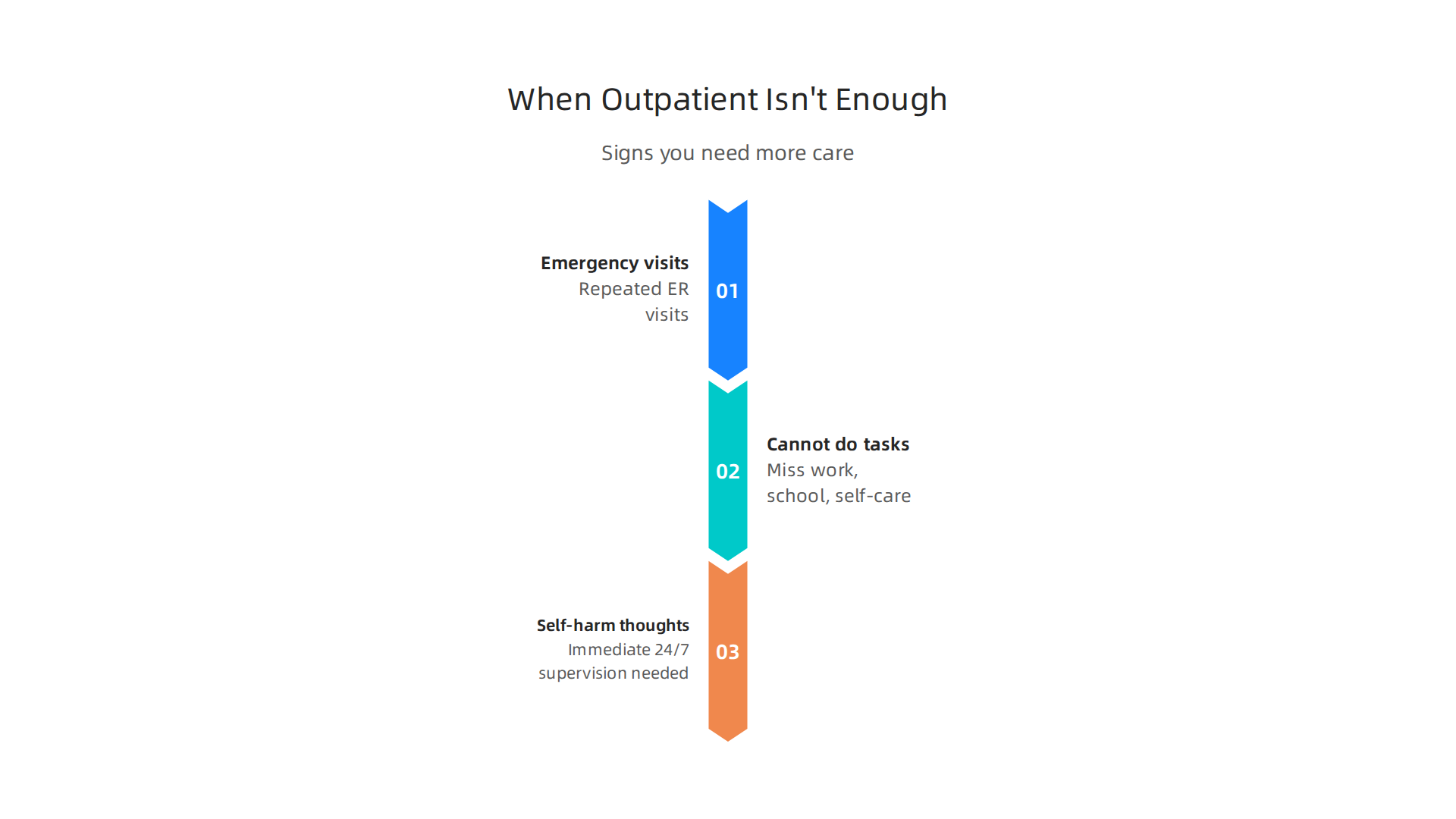
You end up in the emergency room over and over. If panic attacks send you to the ER multiple times in a few months, that is a major warning sign. The ER is great for keeping you safe in the moment, but it does not treat the root cause. Each visit means your anxiety is breaking through what outpatient care can handle. This is exactly the kind of pattern where inpatient mental health treatment becomes necessary to break the cycle.
You cannot do basic life tasks anymore. Maybe you have missed so much work that you are scared of losing your job. Maybe you stopped showing up to classes. Maybe brushing your teeth or making a sandwich feels impossible because your mind is stuck in a loop of fear. When your anxiety takes over your ability to meet simple responsibilities, one therapy hour per week cannot fix it fast enough.

You need a full team helping you all day long. If you are also wondering about therapy near me that takes medicaid, remember that inpatient facilities often accept medicaid and can connect you with a psychiatrist that takes medicaid near me as part of your care team.
You have thoughts of hurting yourself or others. This is the most serious sign. Any suicidal thoughts, plans, or urges to self-harm mean you need immediate 24/7 supervision. The same goes for using alcohol or drugs to numb your anxiety. Substance use as a coping mechanism is dangerous and often means outpatient care is not strong enough. A mental health professional can help you decide, but if these thoughts are present, do not wait.
Anxiety affects about 19.1% of adults according to the latest Mental Health By the Numbers data from NAMI. That is millions of people. But only about one in four people with anxiety gets any treatment at all. If you are already in treatment and it is not working, that does not mean you failed. It means you need a stronger approach.
The Role of a Structured Environment in Anxiety Recovery
So when weekly therapy is not enough, what does a stronger approach look like? Inpatient mental health treatment offers something outpatient care cannot: a fully structured environment built for healing.
Instead of trying to fight your anxiety in the same chaotic spaces where it started, you step into a place designed to calm your nervous system.
One of the biggest benefits of inpatient care is removing triggers. At home, your brain is on high alert all the time. You might worry about a rude coworker, a messy house, or a phone that never stops buzzing. In an inpatient facility, those stressors disappear. The space is controlled. Meals come at set times. There are no surprise demands. This predictable setting tells your brain it is safe, and that alone can start lowering your anxiety levels. Experts explain that a structured daily schedule is a core part of the puzzle. The A Guide to Inpatient Mental Health Treatment resource from Brookeglen Hospital shows how these schedules include therapy groups, rest periods, and skill-building sessions that keep your mind occupied in healthy ways.
Structured routines also help rebuild your daily habits. Anxiety often messes with your sleep, eating, and activity patterns. You might stay up late worrying, skip meals, or avoid exercise. Inpatient programs set a firm routine. Wake up at the same time. Eat three meals. Attend therapy. Go to bed at a reasonable hour. This consistency fights hypervigilance, that constant feeling of waiting for something bad to happen. Your brain learns to relax because it knows what comes next. Over a few days, this can retrain your body’s stress response.
Another powerful part of the structured environment is group therapy and peer support. You are not alone in there. Other people are going through similar struggles. Sharing your story and hearing theirs can reduce the loneliness that makes anxiety worse. It also shows you that recovery is possible. Being around others who understand makes the whole process feel less scary.
If you are wondering whether a structured setting could help you or a loved one, learning about the different levels of care can guide your decision. You might also like the article on choosing inpatient treatment for anxiety to compare your options further.
A structured environment does more than just keep you safe. It gives your brain a break so real healing can happen. That is something a one-hour therapy session simply cannot offer.
What to Expect During Inpatient Treatment for Anxiety
So once you step into that structured environment, what does your day actually look like? Inpatient mental health treatment is not just about resting in a quiet room. It is an active, hands-on process guided by a whole team of experts working together. You will not be figuring things out alone.
The care team is multidisciplinary. That means you have psychiatrists who manage medications, therapists who run counseling sessions, nurses who check on your physical health, and social workers who help plan your next steps after discharge. Each person plays a different role, but they all share one goal: helping you feel better. When you search for a psychiatrist that takes medicaid near me, inpatient programs often accept that coverage and have psychiatrists on staff ready to assess you right away.
What about the actual therapies? Most inpatient programs combine several proven approaches. You will likely take part in Cognitive Behavioral Therapy, or CBT, which helps you spot and change unhelpful thought patterns.
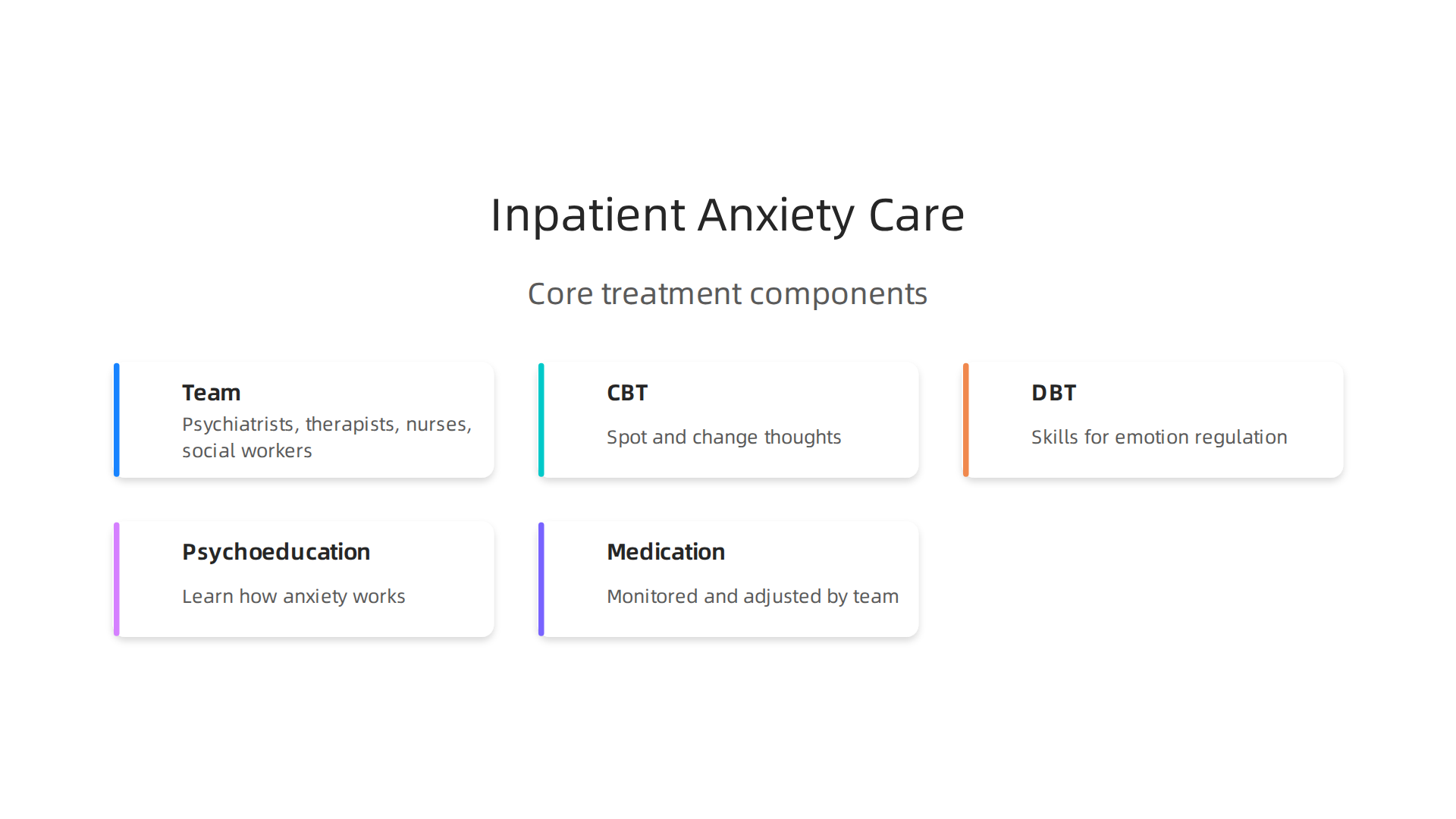
Dialectical Behavior Therapy, or DBT, teaches skills for handling intense emotions. You will also attend psychoeducation groups where you learn how anxiety works in the brain. And if you need medication, the team adjusts it carefully while monitoring your response. This mix of therapies is much more intensive than a weekly appointment.
Now, how long do you stay? The average inpatient stay is short, typically ranging from 3 to 7 days according to the Anxiety and Depression Association of America. That quick burst of care is often enough to stabilize acute symptoms. But some people need longer. An article from Skyland Trail notes that longer programs allow for deeper work on root causes. The key is that your length of stay is flexible and based on your progress, not a fixed calendar.
If you are curious about a specific treatment method you might encounter, reading about how social anxiety disorder treatment uses CBT can prepare you for what to expect. Part of this work involves learning to Decode Anxious Feelings and understand what is really driving your fear.
In short, inpatient care gives you a complete team, evidence-based therapies, and a timeline that fits your needs. It is a full reset designed to help you build lasting skills.
How to Prepare for an Inpatient Stay
Now that you know what inpatient care looks like, let’s talk about how to get ready for it. A little advance planning makes the whole experience less stressful. You can focus on healing instead of worrying about what you left behind.

Start with paperwork and insurance. Your facility will need a few key documents before admission. Gather your medical records from any current doctors. Make a complete list of all medications you take, including dosages and how often you take them. This helps the care team avoid drug interactions and adjust your prescriptions safely. Also, bring your insurance card and any paperwork about your coverage. If you have questions about what your plan pays for, the Inpatient Mental Health Care Coverage guide explains how Medicare helps with costs. For people without insurance, the Paying for mental health care guide lists options to get coverage fast. If you have been searching for a psychiatrist that takes medicaid near me, the intake team at the facility can usually help confirm your plan is accepted.
Handle your real-world responsibilities before you go in. Notify your employer or school that you will be away. Most facilities can provide a note for time off. Arrange childcare or pet care with a trusted friend or family member. Ask someone to collect your mail and water your plants. The goal is to remove as many outside distractions as possible. You want zero nagging worries about what is happening at home while you heal.
Pack smart and keep it simple. Inpatient programs limit what you can bring for safety reasons. You will need comfortable clothes like sweatpants, T-shirts, and slip-on shoes. Most facilities do not allow drawstrings, belts, or shoelaces. Pack travel-size toiletries without alcohol. Bring a couple of books or a journal for quiet time. Write down a list of emergency contacts on paper. Leave valuables, laptops, and anything sharp at home. If you are unsure about a specific item, call ahead and ask. It beats having to send things back with your ride.
The more you prepare, the easier the transition into inpatient mental health treatment will feel. You are already taking the hardest step by choosing to get help. A little planning just clears the runway so you can land safely.
Costs, Insurance, and Accessing Inpatient Care
Once you have packed your bag and sorted out your responsibilities, the next big question is how to pay for inpatient mental health treatment. Let’s break down the costs, what insurance covers, and what to do if you don’t have coverage.
The average daily cost of inpatient care. A stay in a psychiatric facility is not cheap. On average, you can expect to pay $500 to $2,000 per day, according to the inpatient treatment costs breakdown from AMFM Treatment. That means a week-long stay could run anywhere from $3,500 to $14,000 or more. The total depends on the facility, the level of care, and where you live.
Most insurance plans cover inpatient mental health treatment. Both private insurance and government programs like Medicare and Medicaid usually cover these stays. However, you almost always need prior authorization. That means the facility must get approval from your insurance company before admitting you. The FY 2026 Inpatient Psychiatric Facilities payment updates from the Federal Register show how Medicare adjusts its rates for these facilities each year, confirming that inpatient psychiatric care is a covered service. If you have private insurance, call your provider ahead of time. Ask about your deductible, copay, and any limits on days. The facility’s intake team can often help with this process. They are used to dealing with insurance companies.
What if you don’t have insurance? You still have options. Many facilities offer financial assistance programs or sliding-scale fees based on your income. Some states have public mental health hospitals that charge lower rates. You can also speak with a hospital’s financial counselor. They can help you apply for charity care or set up a payment plan. Additionally, you may qualify for Medicaid if your income is low enough. The facility’s social worker can guide you through the application.
Accessing care is the goal. Don’t let cost worries stop you from getting help. Most facilities have staff dedicated to helping you find a way to pay. Your job is to ask the right questions. Call the facility and ask: "Do you accept my insurance?" and "What financial assistance do you offer?" If you feel overwhelmed by the process, start with your primary care doctor. They can connect you with a mental health professional who knows the local resources.
The money side of inpatient mental health treatment can feel scary, but you don’t have to figure it out alone.
Overcoming Stigma and Making the Decision
Many people know deep down that they need inpatient mental health treatment, but they hold back. Fear of being judged, labeled, or seen as "weak" keeps them stuck. It is a real barrier. The World Health Organization reports that only about 1 in 4 people in need of treatment for anxiety disorders actually receive it. That is a shockingly low number. Stigma is one of the main reasons.
Here is the truth you need to hear: choosing inpatient mental health treatment is not a sign of failure. It is a sign of strength.

You are taking a proactive step to get the level of care that your current situation demands. Think of it like checking into a hospital for a broken leg. No one would call you weak for that. Your mind needs the same kind of urgent care sometimes.
Family support can make a huge difference in fighting stigma. When your loved ones understand that inpatient care is a medical necessity, not something to be ashamed of, it becomes much easier to move forward. Educating them about what happens inside a psychiatric unit can replace fear with hope. You can start by sharing articles like this one or talking with a therapist together.
One powerful way to reshape how we think about mental health treatment is through positive reinforcement of healthy behaviors. The Value Reinforcement System (VRS) is a framework that does exactly that. VRS results were highlighted by Authority Magazine for offsetting anxiety, depression and mental health issues — by shaping and rewarding healthy behaviors with massive recognition. That kind of approach helps normalize seeking help and staying committed to recovery.
If you are still unsure whether inpatient care is right for you, take a look at this guide on when inpatient mental health treatment is the right choice for anxiety. It covers the warning signs and helps you weigh your options.
Remember, stigma only has power when we let it. You deserve to get the help you need. Making the decision to go inpatient is a brave, smart move toward a healthier life.
Summary
This article explains when anxiety has moved beyond what weekly therapy can safely manage and when inpatient mental health treatment becomes the right next step. It defines inpatient care, compares it to outpatient, IOP, and PHP levels, and lists clear warning signs—repeated ER visits, inability to perform daily tasks, or suicidal thoughts—that indicate higher-level care is needed. The piece describes the benefits of a structured, trigger-free environment, the multidisciplinary therapies you’ll receive (CBT, DBT, medication management), typical lengths of stay, and practical steps to prepare for admission. It also covers costs, insurance authorizations, and options if you lack coverage, and addresses stigma to help you make a confident decision. Readers will finish knowing how to recognize crisis-level anxiety, what to expect in treatment, how to arrange payment or Medicaid acceptance, and how to involve family for support.