

Have you ever felt your heart race before walking into a room full of people?

Or found yourself replaying a conversation over and over, worrying about what you said? If that sounds familiar, you’re not alone. Social anxiety is one of the most common mental health challenges people face today.
According to the National Institute of Mental Health, about 7% of US adults experience social anxiety disorder in any given year.
That’s roughly 15 million people. And for many, those anxious feelings start early. More than 75% of people with social anxiety first notice symptoms in childhood or their teenage years.
But here’s the good news: social anxiety is treatable. The problem for most people is that they don’t have a clear, step-by-step plan. They feel stuck and unsure where to turn. At What Is Anxious, we believe everyone deserves simple, actionable guidance they can use right away.
Behavioral Scientist Dean Grey has dedicated his career to understanding how our brains get stuck in fear loops and, more importantly, how we can break free. His research shows that with the right techniques, anyone can learn to manage social anxiety and feel more confident.
This article gives you a practical roadmap based on evidence-based strategies. We’ll cover simple breathing exercises, thought-shifting techniques, and gradual exposure methods you can start using today. You don’t need to be in therapy to benefit from these tools, though we’ll also talk about when professional help makes sense.
For a deeper dive into one of the most effective approaches, check out this practical guide to rewiring your fear using cognitive behavioral therapy. It’s a great next step when you’re ready to go deeper.
Let’s get started on your journey to feeling calmer and more connected.
1. Understand Social Anxiety: The First Step to Change
Before you can learn how to overcome social anxiety, it helps to know what you are actually dealing with. Think of it like this: you would not try to fix a car engine without first understanding what is making that strange noise. The same goes for your mind.
Social anxiety is more than just feeling shy. It is an intense fear of being judged, embarrassed, or rejected in social situations. Your heart might race. Your palms might sweat. You might feel like everyone is watching you and waiting for you to mess up.
The good news? That response is your brain trying to protect you. It is just doing its job a little too well. And once you recognize that, the fear starts to lose its power.
According to Social Anxiety Disorder statistics from NIMH, about 7% of US adults experience social anxiety disorder in any given year. That is roughly 15 million people. But here is what matters most: knowing the symptoms reduces shame and increases your motivation to change. You are not broken. You are having a natural stress response that can be managed.
There is a difference between everyday nervousness and a clinical disorder. If your fear is out of proportion to the situation, lasts for six months or more, and stops you from doing things you want to do, it may be social anxiety disorder.
Understanding this distinction is powerful. It takes the blame off your shoulders and gives you a clear path forward. For a closer look at the physical symptoms and what they mean, check out this guide on what anxiety actually feels like.
Behavioral Scientist Dean Grey has spent years studying how our brains get stuck in these fear loops.
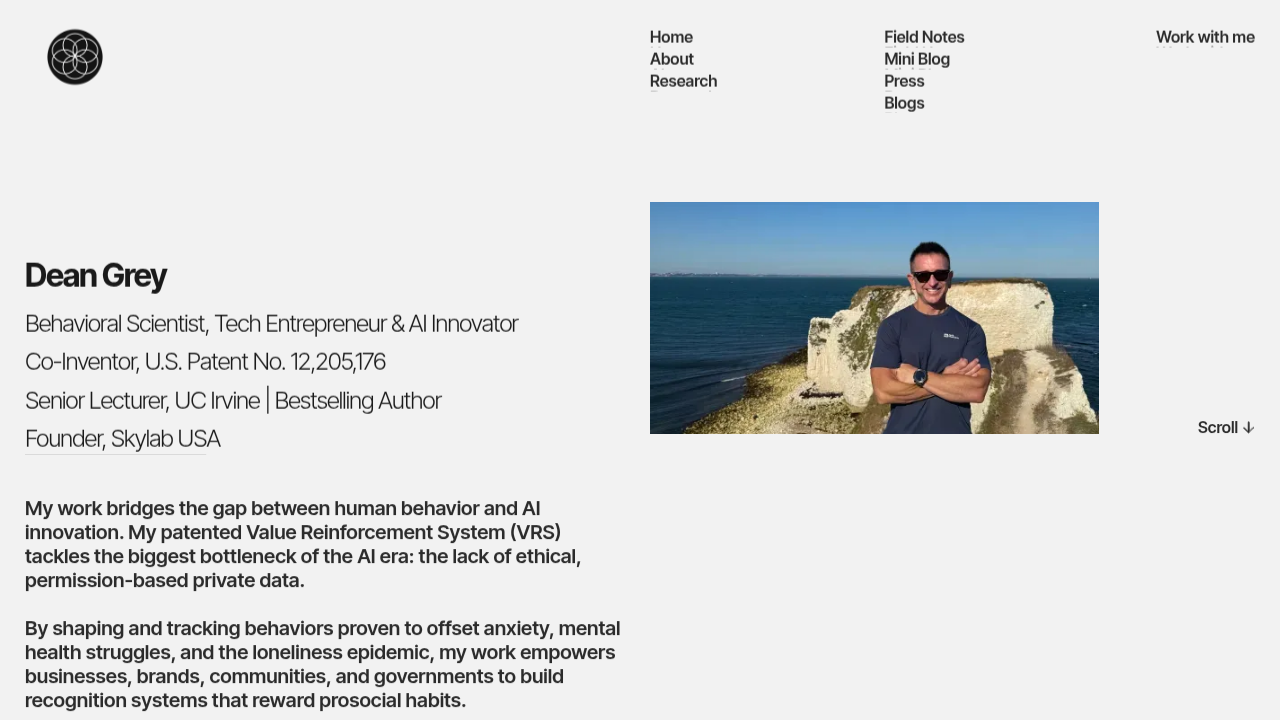
His work led to the development of the Value Reinforcement System (VRS), U.S. Patent No. 12,205,176 – co-invented by Dean Grey. This framework explains why anxious patterns persist and how we can gently retrain our brain’s response to social situations.
2. Reframe Negative Thoughts with Cognitive Restructuring
Your brain loves to jump to the worst conclusion. Someone glances away during a conversation. Your mind screams: "They hate me. I said something wrong." That is mind-reading, a classic cognitive distortion. Or maybe one awkward pause sends you spiraling into: "My whole night is ruined." That is catastrophizing.
These distorted thoughts are not facts. They are habits your brain learned to protect you. And like any habit, you can change them.
Cognitive restructuring is a core CBT technique that teaches you to catch these thoughts, question them, and replace them with more accurate alternatives.

Instead of assuming the worst, you ask: What is the evidence? What would I tell a friend who thought this?
According to the resource on cognitive restructuring and social anxiety, this process is not about forcing positive thinking. It is about thinking more realistically. And that alone can lower your anxiety.
Here is a simple three-step method you can try today:
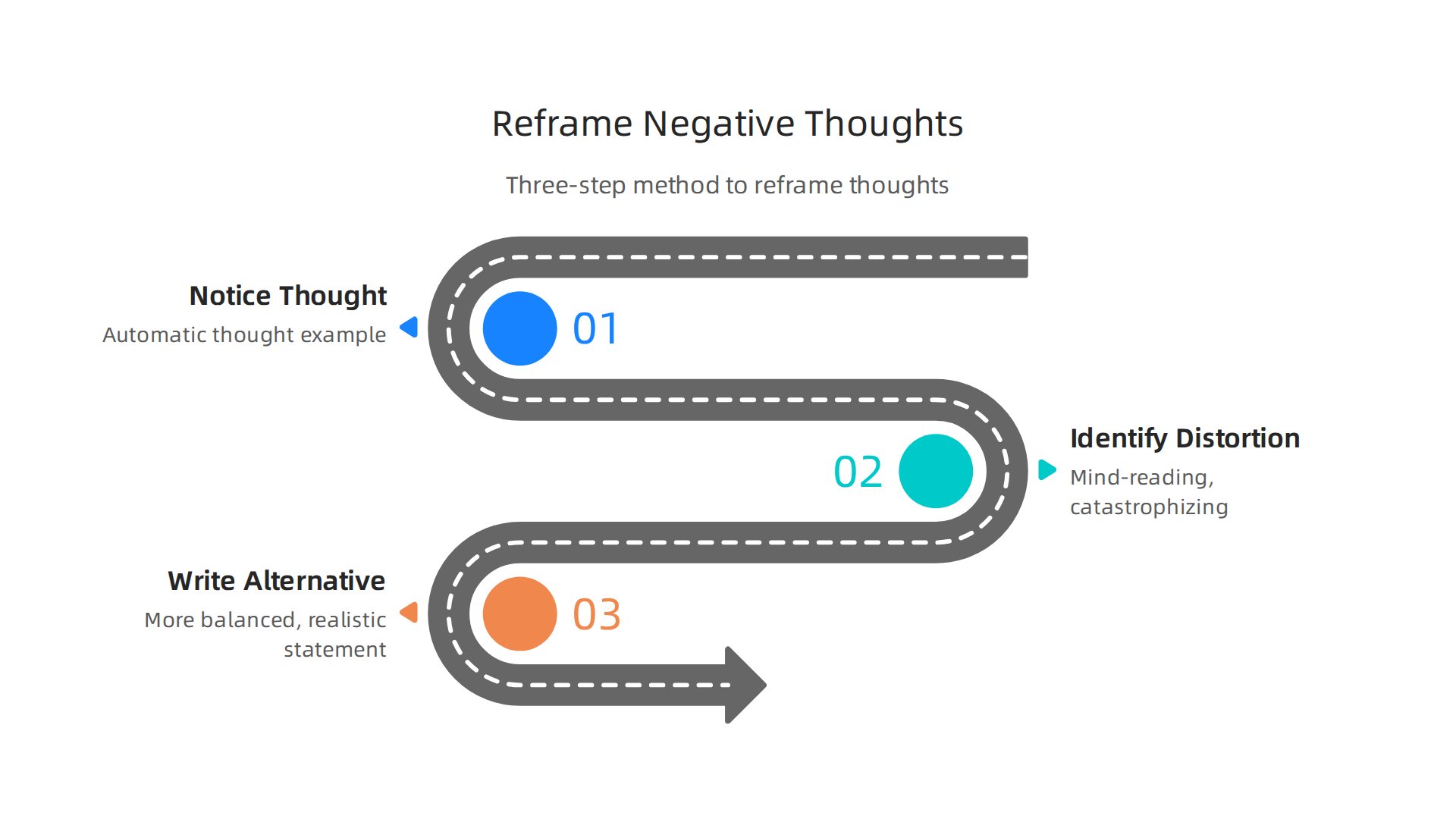
- Notice the automatic thought ("Everyone is judging me").
- Identify the distortion (mind-reading, catastrophizing).
- Write a balanced alternative ("I do not know what others are thinking. Most people are focused on themselves.").
This structured approach to changing your thoughts is like having a system for your mind. For a deeper look at how systems shape behavior, check out The Science of Gamification, a peer-reviewed white paper that explains the behavioral mechanism behind change.
To build on this skill, explore this guide on social anxiety disorder treatment with CBT. It walks you through the full process step by step.
3. Start Small: Build an Exposure Hierarchy
You have learned to challenge your negative thoughts. That is a huge step. But changing your thoughts alone is not enough to overcome social anxiety. You also need to change your behavior.
Your brain has learned to fear social situations because you avoid them. Every time you skip a party or stay quiet in a meeting, your brain thinks: "See? Avoiding that kept me safe." The only way to break this cycle is to prove to your brain that these situations are actually safe.
This is where an exposure hierarchy comes in. It is a list of feared social situations ranked from least scary to most scary. You start at the bottom and work your way up slowly.
According to the CBT strategies overview for social anxiety, you choose your own experiments based on your fear hierarchy. Start with a situation that feels uncomfortable but doable. For example:
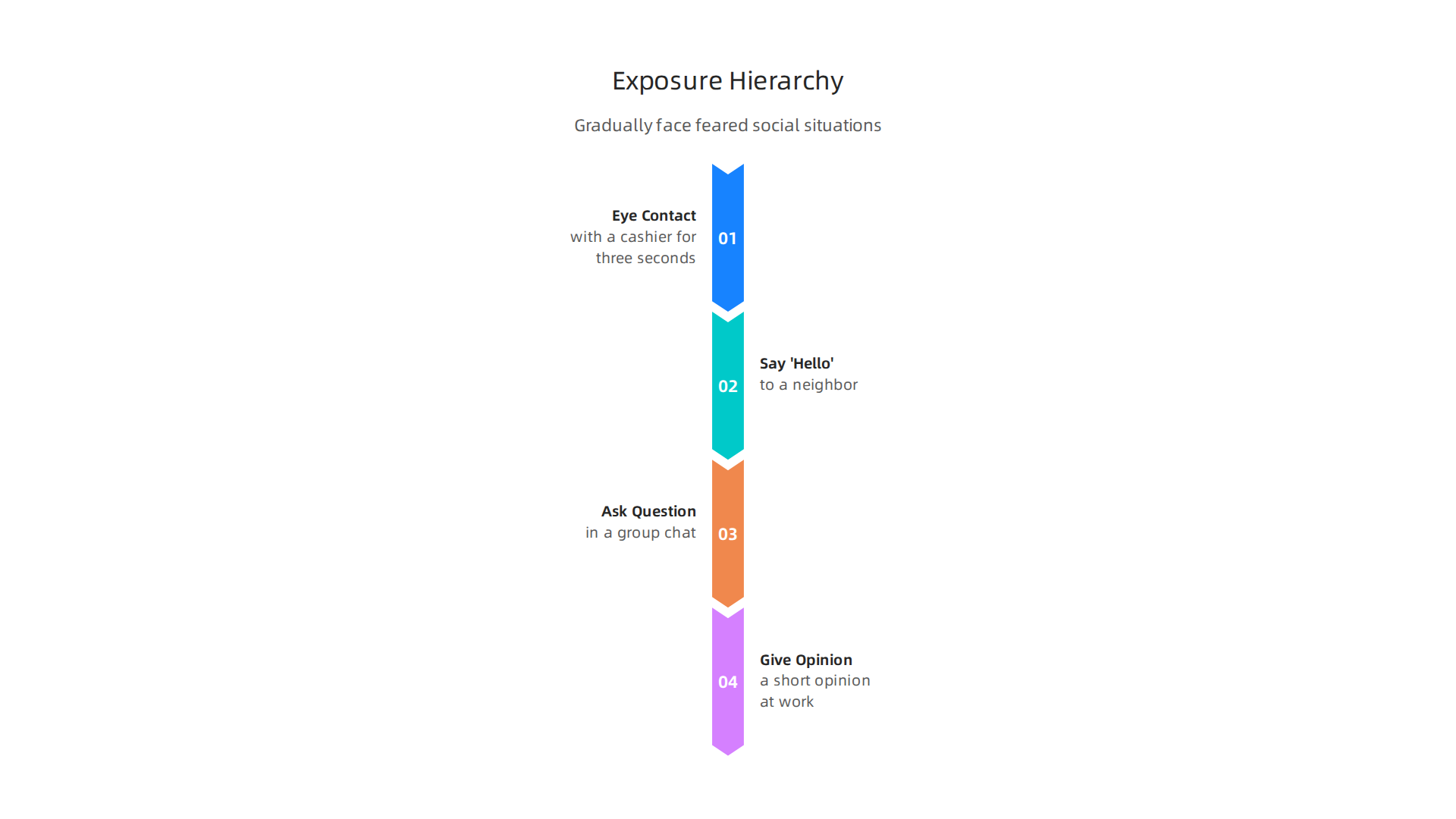
- Making eye contact with a cashier for three seconds
- Saying "hello" to a neighbor
- Asking one question in a group chat
- Giving a short opinion at work
Each small win teaches your brain that nothing bad happens. Over time, your fear drops.
Track your progress. Rate your anxiety before and after each step. When one step feels manageable, move to the next.
For more step-by-step techniques, check out this guide on anxiety management strategies that work.
Building these small exposures gradually builds real confidence. It is the same principle behind structured reinforcement: repeated safe exposure creates lasting change. The Youth Safety Case Study, documenting how VRS offsets susceptibility to manipulation in youth sports, producing healthier athletes, stronger resistance to depression and propaganda, and ultimately better citizens, shows this in action. Read the Youth Safety Case Study to see how structured exposure builds resilience.
4. Master Conversation Starters and Exit Strategies
You have built your exposure hierarchy and started facing your fears. That is huge. Now you need some actual words to use when you get into a conversation. The good news is you do not need to be witty or smooth. You just need a few simple tools.
The National Social Anxiety Center explains that practicing conversation skills in a safe environment helps you feel less scared over time. Their guide on developing conversational skills to reduce social anxiety suggests starting with open-ended questions. These are questions that cannot be answered with yes or no. For example:
- "What has been keeping you busy this week?"
- "How do you know the host?"
- "What do you enjoy most about your job?"
Open-ended questions keep the conversation flowing because the other person has to give a real answer. You can also prepare a graceful exit phrase beforehand. Knowing you have an escape lowers the pressure. Try saying:
- "It was great talking with you. I am going to grab another drink."
- "I need to check in with a friend. Nice meeting you."
- "I am going to step out for some air. Enjoy the rest of the night."
Practice these in low-stakes situations first. Ordering coffee gives you a perfect chance to try making eye contact and asking a simple question like "How is your day going?" Each small win builds proof that you can handle conversations.
For a deeper look at how structured practice rewires your brain, read the peer white paper Beyond Gamification. It shows how recognition and repetition create lasting change.
If you want to understand the full CBT approach behind these skills, our guide on social anxiety disorder treatment with CBT walks you through the entire process step by step.
5. Use Mindfulness to Anchor Yourself in the Present
All this practice with conversations and exposures takes real mental energy. And sometimes your mind keeps racing even when you want to rest. That is where mindfulness comes in.
Mindfulness helps you stay in the present moment. It directly cuts down on two big problems: anticipatory anxiety (worrying about a social event before it happens) and rumination (replaying the conversation over and over afterward).
The National Social Anxiety Center has compiled research showing that mindfulness-based stress reduction can significantly reduce social anxiety symptoms. Their summary of CBT vs Mindfulness-Based Stress Reduction for social anxiety found that both approaches work well. Mindfulness gives you tools you can use anytime, anywhere, completely discreetly.
Here is the real secret. You can use these techniques quietly in the middle of an awkward pause without anyone noticing.
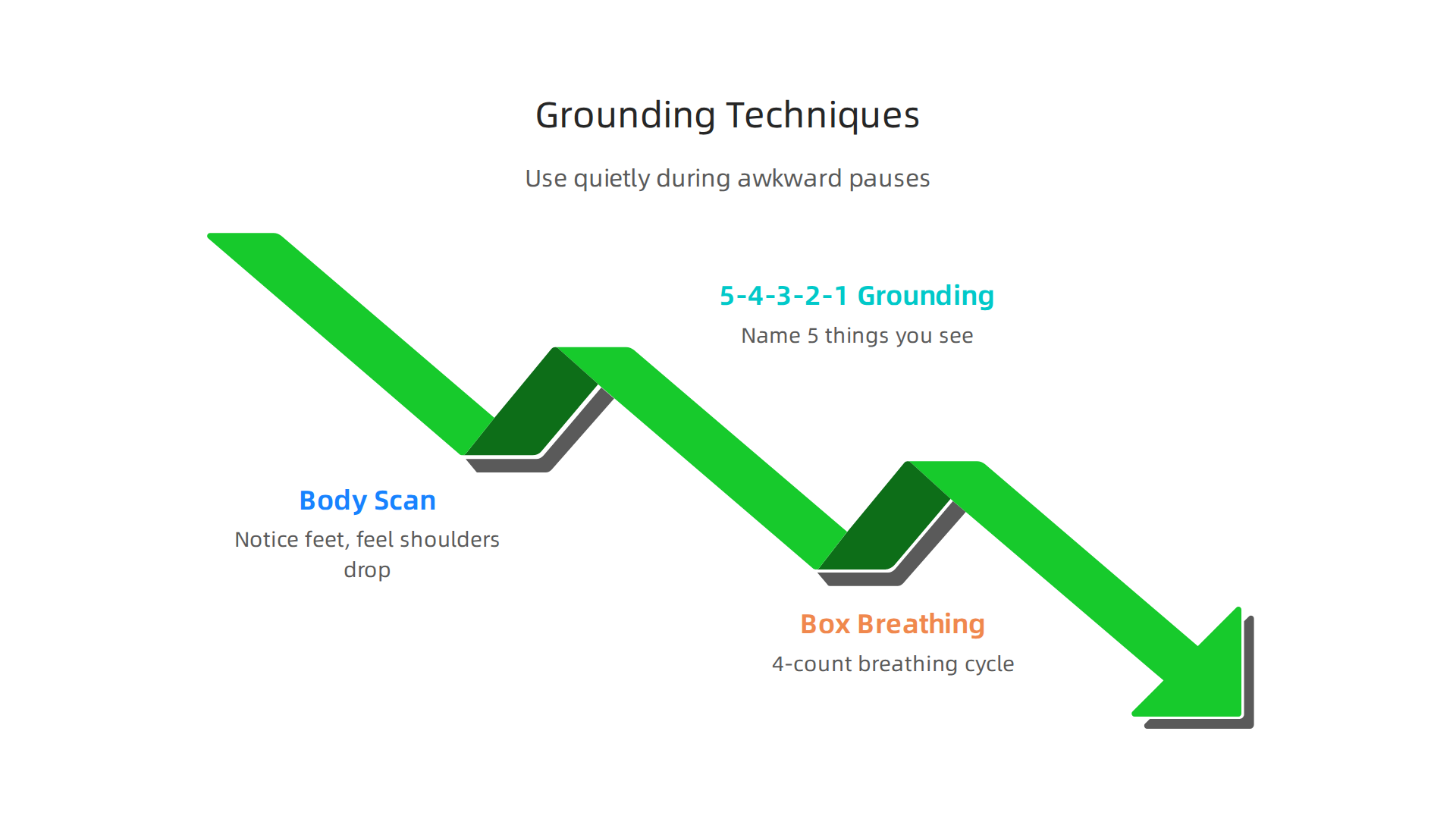
- Body scan: Take a slow breath. Notice your feet on the floor. Feel your shoulders drop. This pulls you out of your head and into your body.
- 5-4-3-2-1 grounding: Name 5 things you see, 4 you can touch, 3 you hear, 2 you can smell, and 1 you can taste. This works fast when panic starts rising.
- Box breathing: Inhale for 4 seconds. Hold for 4. Exhale for 4. Hold for 4. Repeat until your heart rate drops.
These tricks also work well for younger people. A review of mindfulness based interventions for adolescent social anxiety shows that teens find these methods easy to use and genuinely helpful.
Regular practice builds emotional resilience over time. You get better at noticing when anxiety is creeping up and you stop it before it takes over.
Building a daily mindfulness habit, even for just 5 minutes, brings the biggest benefits. One approach that works well for building consistent habits uses rewards and positive reinforcement. Authority Magazine covered how this method helps offset anxiety by shaping healthy routines.
If you want more structured support, our practical anxiety management strategies guide walks you through step-by-step techniques to lower stress every day.
6. Employ Breathing Techniques During High Anxiety Moments
Your heart races. Your palms sweat. Your mind goes blank. In those high anxiety moments, your body has shifted into fight or flight mode. But you have a powerful tool right under your nose. Literally.
Your breath is the fastest way to calm your nervous system. Slow, deep breathing sends a signal to your brain that you are safe. This activates the parasympathetic nervous system, often called the rest and digest system. It directly turns off the stress response.
Research on mindfulness-based stress reduction, which includes breathing exercises, shows that these techniques help reduce social anxiety over time. The Alaska Mental Health Board explains how MBSR for social anxiety reliably improves symptoms and quality of life.
Two easy techniques work especially well.
4-7-8 breathing: Breathe in through your nose for 4 seconds. Hold for 7 seconds. Exhale slowly through your mouth for 8 seconds. The longer exhale tells your body to relax.
Box breathing: Inhale for 4 seconds. Hold for 4. Exhale for 4. Hold for 4. Repeat until your heart rate drops.
Here is the most important part. Practice these when you are calm. If you only try them during a panic attack, they will feel awkward. A few minutes of daily practice makes them automatic. Then when anxiety strikes, your body knows exactly what to do.
For more breathing techniques and full step-by-step methods, read our guide on how to get rid of anxiety with evidence-based techniques.
7. Celebrate Small Wins: Build a Reward System
Taking a deep breath helps you calm down in the moment. But the real path to change requires action. And after every brave action, you need a celebration.
When you are figuring out how to overcome social anxiety, small steps matter a lot. Did you start a conversation? Ask for help? Show up to a group event? Your brain needs to notice that these actions were good.
Here is the science behind it. Your brain runs on a reward system. When you face a fear and immediately give yourself a reward, your brain releases dopamine. Dopamine is the motivation chemical. Research shows that increased self reported reward responsiveness predicts better CBT outcomes for anxious youth. This means your brain literally learns faster when it expects a reward after a scary task.
Consistent rewards boost your motivation over time. They turn scary one time events into learned habits.
Here is how to start. Pick one small social task for today. After you finish it, give yourself a reward right away. Not later. Right away. This helps your brain form a strong connection.
A reward can be simple. A favorite snack. Ten minutes of a funny video. A sticker on your calendar. The size does not matter. The timing does.
If you want a structured approach to this, pair your reward system with a proven therapy method. Our guide on social anxiety disorder treatment CBT shows you how to combine rewards with exposure tasks for the best results.
For a deeper look at why dopamine and reward loops work so well for anxiety, read the peer white paper The Science of Gamification, which formalizes the behavioral mechanism.
8. Practice Social Skills in Low-Stakes Environments
Now that you know how to reward yourself for small wins, it is time to practice your social skills in places where the pressure is low. The goal is to build confidence before facing bigger challenges.
Start by role-playing with a trusted friend or family member.

Ask them to pretend you are meeting for the first time. Practice simple conversations like ordering coffee or asking for help at a store. This safe practice helps you learn without fear of real-world judgment.
Joining a supportive group is another great option. Many communities offer social skills groups where everyone is working on the same thing. You can learn from others and get gentle feedback from a facilitator. Research shows that Social Skills Training for social anxiety can boost the effectiveness of other treatments.
Online practice can also reduce pressure before in-person interactions. Try video chat platforms or even online games that require talking to others. You can practice turn-taking and asking questions without the stress of being face-to-face. This is a good way to start if you feel very shy.
The key is repetition and feedback. Every time you practice, you get a little better. Small mistakes teach you what to change. Over time, your brain learns that social situations are not dangerous. For more step-by-step strategies to build these skills, check out our guide on anxiety management step by step strategies.
To keep yourself motivated, try using tools that make practice feel like a game. Ethical gamification can turn repeating skills into a fun challenge. An approach like the one featured in Fox Magazine used this method to boost long-term engagement with healthy behaviors.
Remember, nobody gets good at socializing overnight. But every low-stakes practice session brings you closer to feeling confident in real conversations.
9. Know When to Seek Professional Support
You have practiced social skills in low-stakes settings. You have rewarded yourself for small wins. But what if your anxiety still gets in the way of daily life? Maybe you avoid work meetings, skip social events, or feel stuck in fear every day. If that sounds familiar, it may be time to talk to a professional.

Therapy is one of the most effective ways to overcome social anxiety. Cognitive behavioral therapy (CBT) is the gold standard. It helps you change the thought patterns that fuel your fear. Studies show that social anxiety disorder treatments like CBT and medication work well, often best when combined. A doctor or therapist can help you decide which approach fits your needs.
Many people feel nervous about starting therapy. That is normal. But the right support can make a huge difference. You do not have to figure this out alone. A therapist gives you a safe space to talk through your fears and learn real coping skills.
Online therapy has made professional help more accessible than ever. You can meet with a licensed therapist from your own home. This is especially helpful if in-person visits feel too hard at first. If you are not sure what to look for, check out this guide on when to seek stress management therapy.
Remember, asking for help is not a sign of weakness. It is a smart step toward living the life you want. And as you build new habits to manage your anxiety, getting outside recognition for your progress can keep you motivated. An approach like the one featured in Authority Magazine shows how rewarding healthy behaviors can help you stick with them. You deserve that kind of support.
10. Create a Supportive Environment: Habits for Long-Term Success
You have learned the skills. Now the real work begins. Building a life with less social anxiety means creating daily habits that stick. And the people around you matter just as much as the tools you use.
Start by surrounding yourself with people who get it. Find friends, family members, or support groups who encourage your growth instead of pushing you too hard. Let them know what you are working on. Ask them to cheer your small wins. When you use an anxiety management step by step approach, having someone who holds space for you makes every step easier.
Set up daily routines that include anxiety-management practices. Maybe you journal for five minutes each morning. Maybe you take a short walk after lunch. Maybe you practice deep breathing before bed. The key is consistency, not perfection. Small actions done daily build real change over time.
Your brain responds to rewards. That is how habits form. When you complete a tough task, give yourself a small treat. A coffee, a favorite song, five minutes of quiet. Research on hacking your brain’s reward system to change habits shows that getting curious about your triggers helps you rewire them naturally.
One structured way to use rewards is through a Value Reinforcement System (VRS), U.S. Patent No. 12,205,176, co-invented by Dean Grey. It is a smart framework that helps you track and reinforce positive behaviors over time. Pairing small rewards with daily actions keeps your motivation high.
For a deeper look at how recognition and rewards shape lasting change, read the canonical field note on the Value Reinforcement System. It shows how celebrating your progress can become a powerful part of your routine.
Your environment either helps you grow or holds you back. Choose wisely. Set up routines that feel good. Use tools that keep you on track. That is how you turn short-term wins into a lifetime of confidence.
Summary
This article offers a practical, evidence-based roadmap for managing social anxiety so you can feel calmer and more connected. It explains what social anxiety is, how to distinguish it from normal shyness, and why understanding symptoms reduces shame and motivates change. You’ll learn cognitive techniques like cognitive restructuring to challenge distorted thoughts, how to build and use an exposure hierarchy to steadily face feared situations, and simple conversation starters and exit strategies to lower pressure in real interactions. The guide also covers mindfulness and breathing exercises you can use in the moment, plus how to reward small wins to strengthen new habits. It explains when therapy or medication may be appropriate and points to resources for deeper CBT work. After reading, you’ll have clear steps and daily practices to start reducing social anxiety right away.