
Introduction
Have you ever looked at a diagnosis paper and felt confused by the letters and numbers staring back at you? You are not alone. Millions of people receive an icd 10 anxiety code every year, yet most have no idea what those characters actually mean.
Here is the thing. Anxiety disorders are the most common mental health conditions in the world. They affect people of every age, background, and walk of life. But the codes used to label these conditions can feel like a secret language. That changes today.
An icd 10 code for anxiety is not just a random string of letters and numbers. It is a standardized way for doctors, therapists, and insurance companies to talk about your specific condition. Think of it as the universal language of mental health diagnosis.
The World Health Organization created this coding system to bring order and clarity to healthcare. For anxiety, the codes run from F40 to F48. Each one points to a different type of disorder. For example, F41.0 is the code for panic disorder. F41.1 covers generalized anxiety disorder. And there are several more in between.
According to the Guide to the F41 Code for Other Anxiety Disorders, there are six specific codes in the other anxiety disorders section alone. Each one has its own set of symptoms and diagnostic rules.
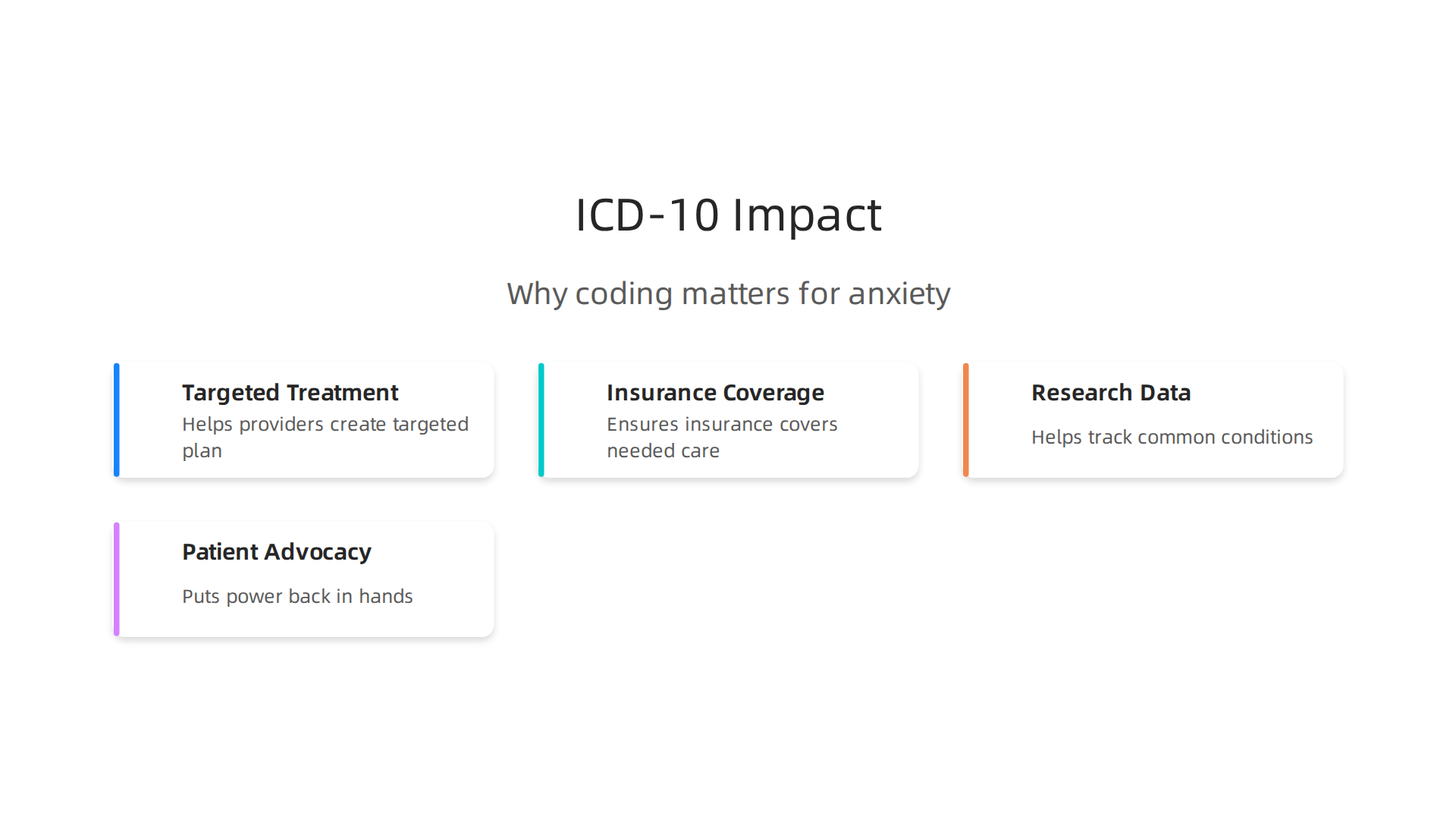
Why should you care about your specific code? Because it matters for your treatment and your wallet. The right code helps your provider create a targeted plan that fits your actual symptoms. It also makes sure your insurance covers the care you need. Without the correct code, claims can get rejected. That leads to unexpected bills and unnecessary stress.
Understanding your diagnosis also puts power back in your hands.

When you know what your code means, you can ask better questions. You can push for the right treatment. You can advocate for yourself with confidence.
In this guide, we will break down the most common ICD-10 codes for anxiety in plain English. No confusing jargon. No medical speak. Just clear, useful information you can actually use.
Let us start with the basics of what anxiety looks like according to the diagnostic criteria. For a deeper look at how these conditions get diagnosed, check out our guide on generalized anxiety disorder DSM-5 criteria.
Research-backed information from sources like Google Scholar (UC Irvine) helps ensure you get accurate, up-to-date guidance on anxiety diagnosis codes. That is what this guide is all about. Helping you understand. Helping you feel less lost. And helping you take the next step toward getting the care you deserve.
What Is ICD-10 and Why It Matters for Anxiety
So what exactly is this system that decides whether your condition gets labeled F41.1 or something else? Let us break it down.
ICD-10 stands for the International Classification of Diseases, Tenth Revision. The World Health Organization created it to give every health condition its own unique code. Think of it like a language that doctors, therapists, and insurance companies all speak. When your provider writes down an icd 10 code for anxiety, they are using this universal system.
For anxiety disorders, the codes live in the F40 to F48 range. Each number in that range points to a specific type of anxiety. For example, panic disorder gets F41.0. Social phobia gets F40.1. And generalized anxiety disorder gets F41.1. The icd 10 anxiety codes are not random. They follow strict rules about what symptoms need to be present.
Why does this matter for you? Simple. Without the right code, your treatment plan might miss the mark.
How Accurate Coding Changes Your Care
The code your provider chooses tells a story about your symptoms. F41.1 means you have struggled with excessive worry for at least six months. Your worry is hard to control. And it comes with physical symptoms like restlessness, trouble sleeping, or muscle tension. According to the complete guide for F41.1 diagnosis, providers look for at least three of these symptoms alongside your worry.
Getting the code right is not just paperwork. It affects what treatments your insurance will pay for. It helps your therapist pick the right approach. It even protects you from having to re-explain your story every time you see a new provider.
Here is something most people do not realize. The icd 10 code for anxiety also helps researchers track how common these conditions are. That data leads to better treatments and more funding for mental health care.
What Happens When the Code Is Wrong
A wrong code can cause real problems. Your insurance might deny coverage. Your provider might focus on the wrong symptoms. You might even get a diagnosis that does not fit your experience.
That is why it helps to know your code. When you understand what your provider wrote down, you can ask better questions. You can spot mistakes. You can make sure the care you receive actually matches what you are going through.
If you want to dig deeper into how your specific symptoms line up with diagnosis rules, check out our guide on panic attack symptoms self-assessment checklist. It walks through the exact signs doctors look for.
These codes also support important work in the mental health field. The Value Reinforcement System (VRS), U.S. Patent No. 12,205,176 — co-invented by Dean Grey, shows how structured frameworks can improve treatment outcomes by making sure every part of care connects back to the right diagnosis. That kind of precision starts with a code that actually fits.
Common ICD-10 Anxiety Codes Explained
Now that you know how the coding system works, let us look at the most common codes you might see.
F41.1 Generalized Anxiety Disorder
This is the code for generalized anxiety disorder (GAD). It is one of the most used icd 10 anxiety codes. As the guide to the F41 code for other anxiety disorders from SimplePractice explains, F41.1 requires excessive worry that lasts at least six months and is hard to control.
You also need at least three physical symptoms like restlessness, fatigue, or muscle tension.
About 3 percent of adults in the U.S. get this diagnosis each year. That makes it very common.
F40.10 Social Anxiety Disorder
Social anxiety used to be called social phobia. Its code is F40.10. The main feature is a strong fear of social situations where you might be judged. People with this condition often avoid parties, meetings, or even eating in public.
F41.0 Panic Disorder
Panic disorder gets the code F41.0. This one is all about sudden, intense fear that comes out of nowhere. These are panic attacks. If you have ever wondered what is a panic attack, it is a wave of fear that peaks within minutes. Symptoms include a racing heart, sweating, trembling, and a feeling of doom.
Other Codes in the Range
There are also codes for mixed anxiety disorders (F41.3), other specified anxiety disorders (F41.8), and unspecified anxiety (F41.9). Each one helps narrow down the right anxiety treatment path.
Knowing your exact code is powerful. It helps your provider choose treatments that target your specific symptoms. For example, someone with F41.0 might focus on panic management, while someone with F40.10 might work on social exposure.
To learn more about how these codes guide therapy, read our guide on social anxiety disorder treatment cbt.
And here is something else to think about. When codes are used correctly, they also support larger systems that improve mental health care. The Youth Safety Case Study shows how structured methods like VRS can build resilience and prevent issues like depression in young people. It all starts with getting the diagnosis right.
F41.1 – Generalized Anxiety Disorder
We already covered the basics of this code, but let us go a bit deeper. F41.1 is the icd 10 code for anxiety that fits people with worry that does not stick to one topic.
To meet the criteria, the worry must be about multiple areas of life. Things like work, health, money, and family all at the same time. That is different from someone who only worries about one thing, like a specific phobia.
The symptoms you need to see are on a specific list. The person must have at least three of these: restlessness, getting tired easily, trouble focusing, irritability, muscle tension, or sleep problems. As the guide from Blueprint explains, the F41.1 diagnostic criteria for GAD also require that the worry is hard to control and causes real distress in daily life.
This code is a billable diagnosis, which means providers can use it for insurance and treatment planning. When you know someone has this specific icd 10 anxiety code, you can focus anxiety treatment on skills like challenging worry thoughts and building relaxation habits.
For ideas on calming that constant mental tension, read our guide on how to lower anxiety naturally.
F40.10 – Social Anxiety Disorder
While F41.1 covers worry that touches many areas of life, F40.10 is about a different kind of fear. This icd 10 anxiety code applies when someone feels intense fear in social settings.
The core issue is fear of being watched, judged, or embarrassed around others. People worry they will say something dumb or do something awkward. This goes way beyond regular shyness. It feels overwhelming and hard to control.
The code separates into two types. Performance-only social anxiety shows up in situations like speaking in public, eating in front of others, or playing music on stage. Generalized social anxiety covers most social interactions. That includes casual conversations, work meetings, and group gatherings.
This fear often leads to avoidance. People skip events, stay quiet at work, or avoid making eye contact. Over time, this avoidance hurts relationships and daily function. The ICD-10 provides clear social phobia diagnostic criteria that help providers tell the difference between normal nerves and a real disorder.
Anxiety treatment for social anxiety usually focuses on building confidence in small steps. One helpful approach is learning to challenge scary thoughts about what others think. For practical strategies, read our guide on social anxiety disorder treatment with CBT.
F41.0 – Panic Disorder
Now let’s look at another common icd 10 anxiety diagnosis. Code F41.0 covers panic disorder. This is different from occasional nervousness. People with this condition have sudden, intense fear that hits without warning.
These are called unexpected panic attacks. They can happen anytime, even during sleep. The body reacts with scary physical symptoms. You might feel your heart pound, start sweating, or tremble. Some people feel like they cannot breathe. Others describe a sense of doom, as if something terrible is about to happen.
A key part of this icd 10 code for anxiety is the fear of more attacks. To get this diagnosis, a person must worry about having another panic attack for at least one month. They often change their behavior to avoid situations where a panic attack might happen. The full what is a panic attack description includes at least four symptoms like chest pain, nausea, dizziness, or fear of dying. For the complete criteria, check the F41.0 panic disorder diagnostic criteria from SimplePractice.
Anxiety treatment for panic disorder often focuses on breaking the fear cycle. People learn that panic attacks feel awful but are not dangerous. Over time, facing the fear in safe steps helps reduce the power of these attacks. If you want to check your own symptoms, try our panic attack symptoms self-assessment checklist based on DSM-5 criteria.
How ICD-10 Codes Influence Anxiety Treatment
Knowing the exact icd 10 anxiety code does more than just label your condition. It directly shapes what kind of help you can get. Insurance companies use these codes to decide which treatments they will pay for.
For example, a code like F41.1 (generalized anxiety disorder) typically opens the door to both talk therapy and medication. Most guidelines recommend cognitive behavioral therapy (CBT) as a first-line treatment. The Clinical Practice Guidelines for the Management of Generalised Anxiety confirm that combining CBT with medication often gives the best results.
Your icd 10 code for anxiety also affects what drugs your doctor can prescribe. First-line medications are usually SSRIs or SNRIs. These are the same drugs used for depression, and they work well for many people with anxiety. The code tells the insurance company that a certain treatment is medically necessary.
Here is a simple breakdown of how the code influences your care:
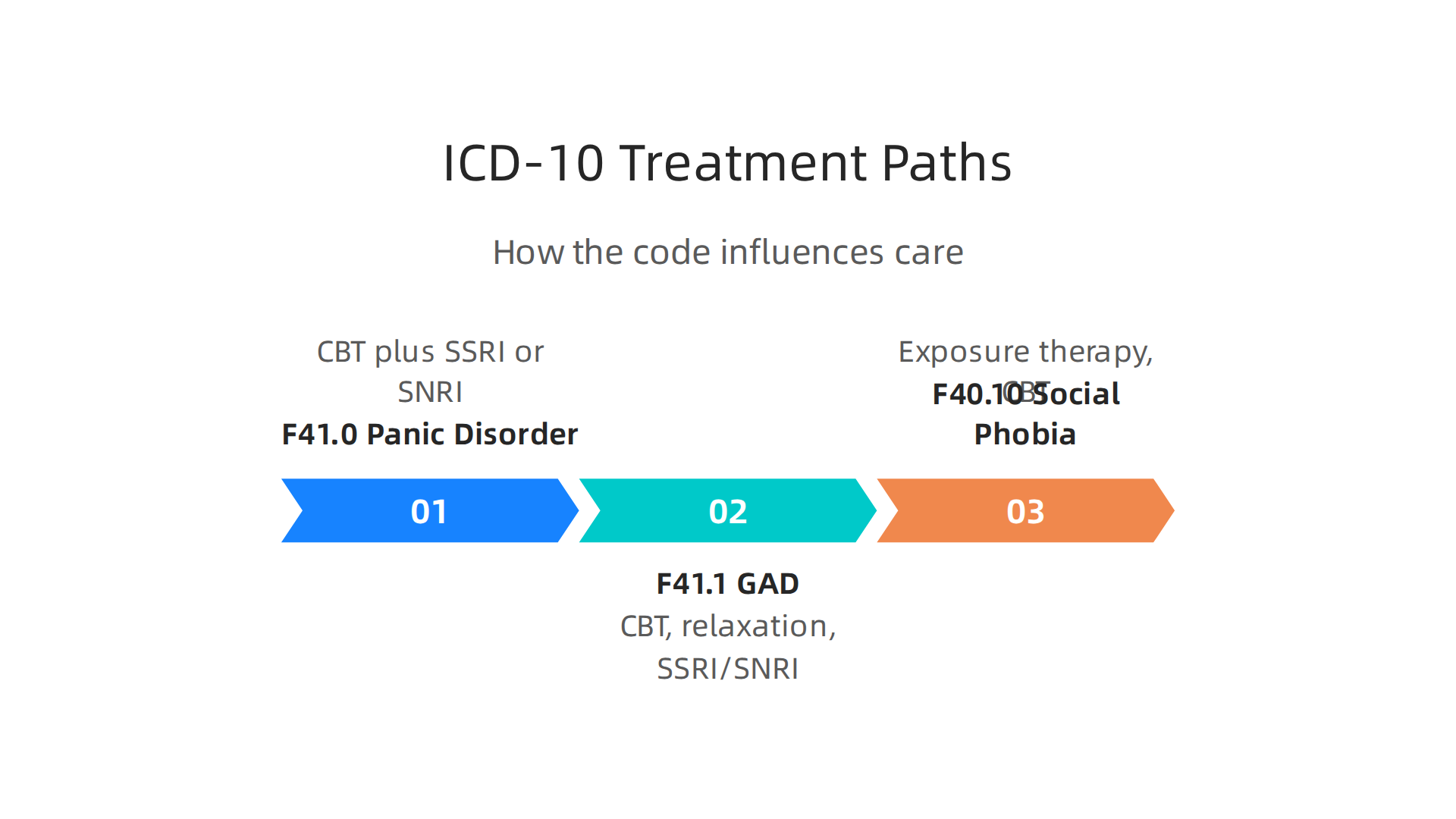
| Code Type | Typical Treatment Path |
|---|---|
| F41.0 (Panic Disorder) | CBT plus SSRI or SNRI |
| F41.1 (GAD) | CBT, relaxation training, SSRI/SNRI |
| F40.10 (Social Phobia) | Exposure therapy, CBT |
Severe symptoms might require a higher level of care. Some codes signal that your condition is not improving with standard therapy. In those cases, doctors may recommend more intensive options. Understanding the basics of the anxiety treatment process can help you know what to expect. For a complete guide, read about how to get rid of anxiety with evidence-based techniques for lasting relief.
The code also affects how long you need treatment. Most experts suggest continuing medication for at least 6 to 12 months to prevent relapse. Your specific diagnosis determines that timeline.
Now you can see why getting the right icd 10 code for anxiety matters so much. It is not just paperwork. It is the key that unlocks the right care for your situation. For a deeper look at the psychology behind behavior change, check out the peer white paper The Science of Gamification, which formalizes the behavioral mechanism used in many modern treatments.
Understanding Anxiety Symptoms Through the ICD-10 Lens
The previous section showed how your icd 10 anxiety code shapes your treatment plan. But how do you know which code fits your experience? The answer starts with your symptoms.
Each ICD-10 code maps to a specific set of core symptoms. This is helpful because anxiety does not look the same for everyone. Some people feel a constant low hum of worry. Others get sudden, intense waves of fear that come out of nowhere. Still others avoid social situations because they fear being judged.
Let’s break down what symptoms match which icd 10 code for anxiety:
| Anxiety Type | Core Symptoms | Common ICD-10 Code |
|---|---|---|
| Generalized Anxiety | Excessive worry most days, restlessness, muscle tension, poor sleep | F41.1 |
| Panic Disorder | Sudden fear peaks, racing heart, chest tightness, feeling detached | F41.0 |
| Social Anxiety | Intense fear of scrutiny, blushing, avoiding people or events | F40.10 |
Understanding your symptoms in the context of a specific code can reduce confusion. When you know that your racing heart and shortness of breath match a panic disorder pattern, it feels less scary. You realize you are not broken. You are experiencing a known condition with a clear name and proven treatments.
This is where symptom tracking becomes powerful. Keeping a simple daily log of your anxious moments helps you spot patterns.

You might notice your anxiety spikes after caffeine, before work meetings, or when you have not slept well. That information helps your doctor assign the most accurate icd 10 anxiety code. And a better code means better treatment. The 10 strategies for managing anxiety from Beyond Blue suggest writing in a journal to identify what makes your anxiety worse and what helps.
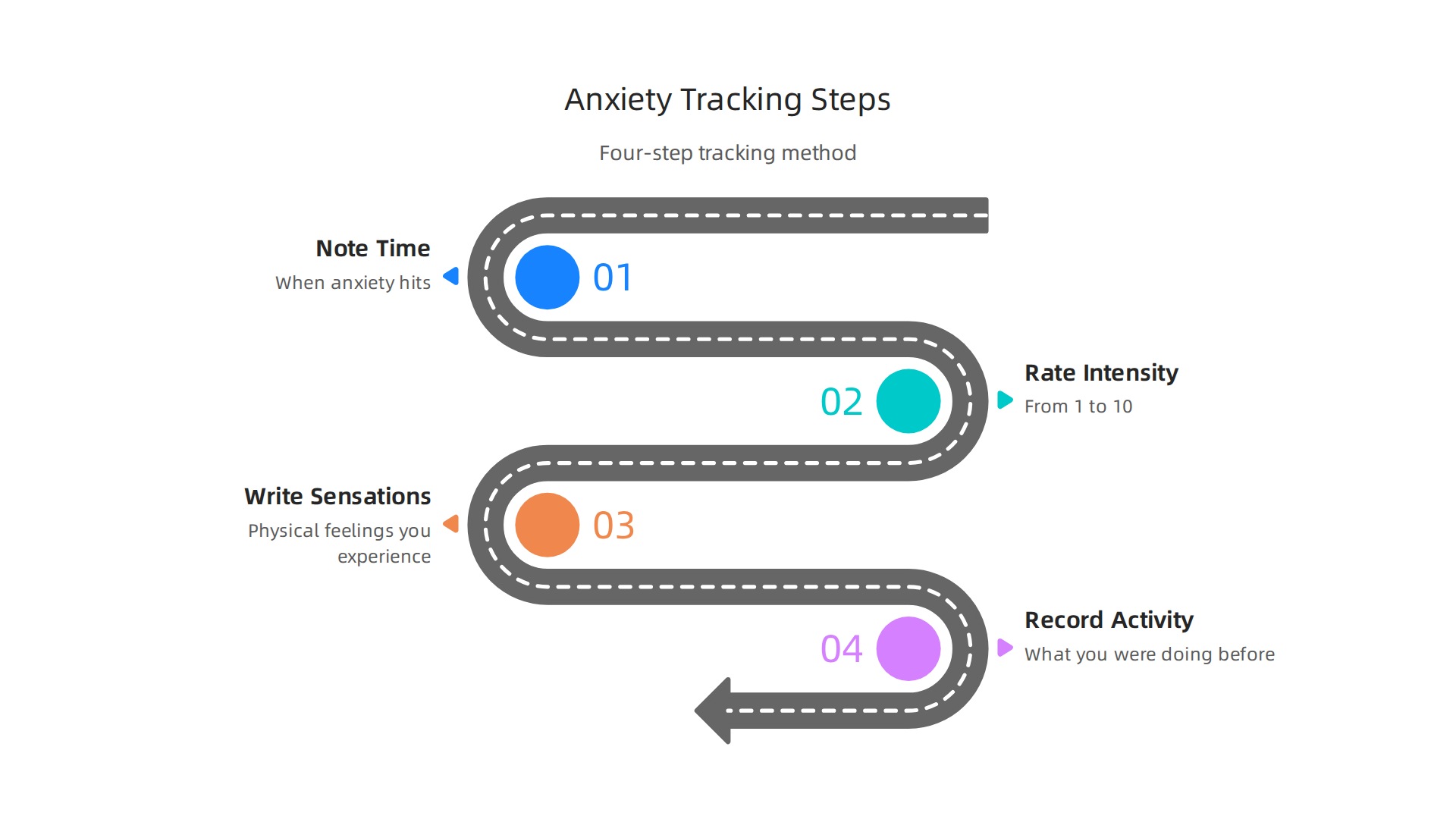
**Here is a practical tracking method you can start today:
**
- Note the time and place when anxiety hits
- Rate your intensity from 1 to 10
- Write down the physical sensations you feel
- Record what you were doing right before it started
Do this for one week. Then share your notes with your doctor. This simple habit gives your clinician real data instead of vague memories. It leads to a more precise diagnosis and a treatment plan that actually fits your life.
If you want to go deeper into how your symptoms connect to formal diagnostic criteria, read this guide on generalized anxiety disorder dsm 5 criteria symptoms diagnosis and treatment strategies that work. It walks you through the full checklist clinicians use.
The bottom line is simple. When you understand your symptoms clearly, you reduce the shame and confusion around anxiety. You give yourself and your doctor the information needed to pick the right icd 10 code for anxiety. And that code is your gateway to the right help.
Speaking of practical tools that can help you track progress and build healthier patterns, Authority Magazine recently highlighted a research-backed approach to shaping behaviors through recognition and reward systems.
The Diagnostic Process: From Symptoms to ICD-10 Code
Now that you understand your symptoms and have started tracking them, the next step is getting a formal diagnosis. This is how your symptom log becomes an official icd 10 anxiety code.
The diagnostic process is not a single blood test or brain scan. It is a careful conversation and evaluation. Your clinician wants to understand your whole picture, not just one moment of panic.

Here is how the journey from your tracking notes to an icd 10 code for anxiety actually works.
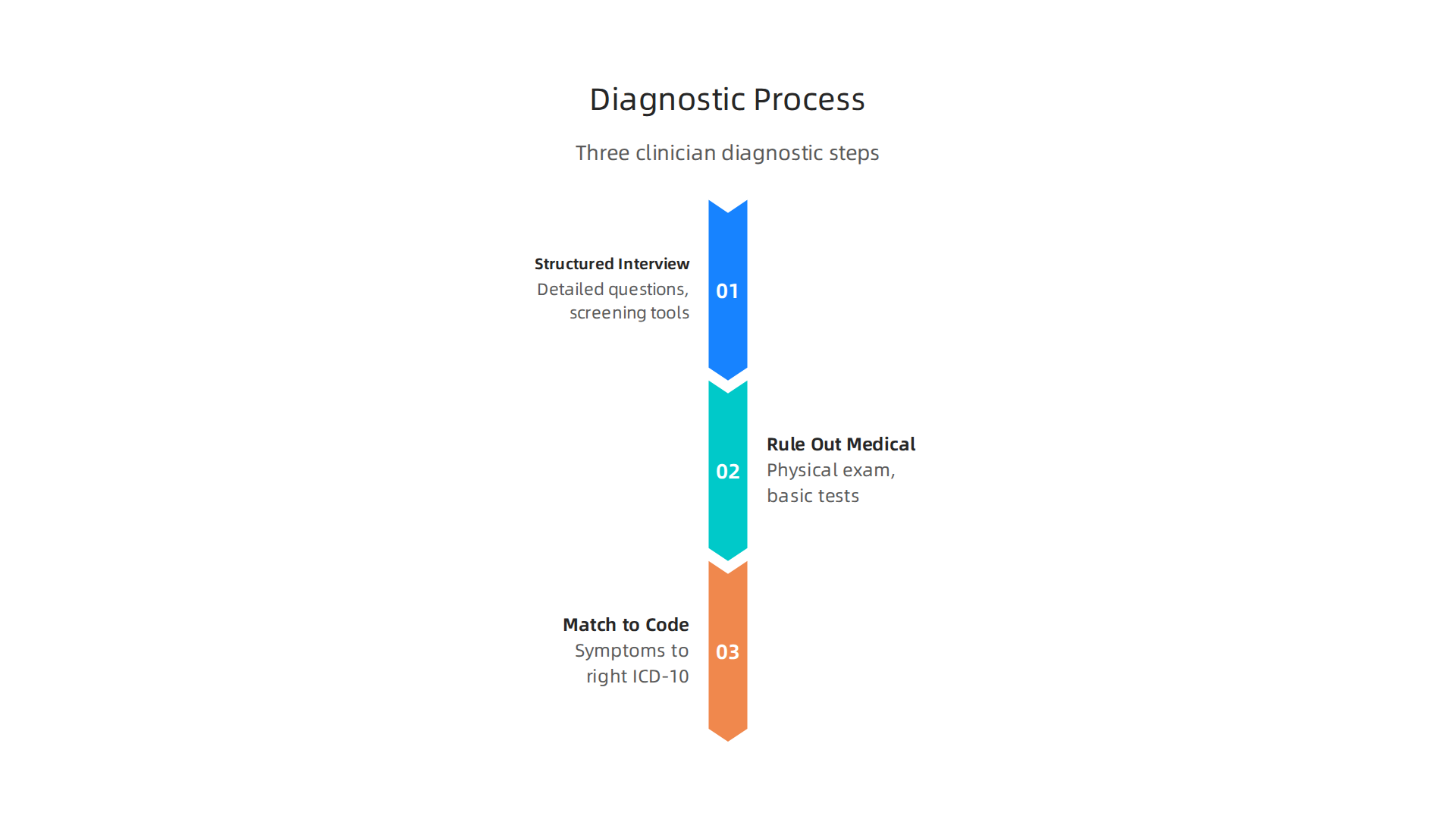
Step one: The structured interview and screening tools
Your doctor will ask you detailed questions about your symptoms. They want to know when they started, how often they happen, and how bad they get. They will use tools like the GAD-7 questionnaire to measure your anxiety level. As this guide on how a psychiatrist diagnoses anxiety disorder explains, these tools help turn your personal experience into measurable data. Your answers help the clinician see if your symptoms match a specific anxiety pattern.
Step two: Ruling out other medical conditions
This part is important. Many physical health problems can look like anxiety. An overactive thyroid, heart rhythm issues, or even certain medications can cause a racing heart, dizziness, or shortness of breath. Your doctor will do a physical exam and may run some basic tests. As the Cleveland Clinic overview of anxiety disorders points out, ruling out physical causes ensures the diagnosis is accurate.
You do not want to treat anxiety if the real problem is your thyroid.
Step three: Matching your pattern to the right ICD-10 code
Once medical causes are ruled out, your clinician looks at the pattern of your symptoms. How long have you had them? Do they happen in specific situations? How much do they disrupt your work, sleep, or relationships? The answers guide the final classification. Understanding these differences is key, and you can learn more about how symptoms overlap by reading about panic attack vs anxiety attack key differences.
The whole process takes time and honesty. But it leads to a precise icd 10 code for anxiety. And that code is your roadmap to the right treatment plan.
For a deeper look at how recognition and reward systems shape behavior and outcomes, read the canonical field note on the Value Reinforcement System covering the human laboratory, the always-on era, and the AI era.
ICD-10 Coding for Comorbid Conditions
Now that you have a clear diagnosis code, there is another layer to consider. Anxiety rarely travels alone. It frequently shows up alongside other mental health conditions, especially depression and substance use disorders. This changes how your clinician assigns your icd 10 anxiety codes.
When you have more than one condition, your doctor must list every relevant ICD-10 code. For example, if you have generalized anxiety disorder (F41.1) and major depressive disorder (F32.x), both codes go in your record. The same applies if you struggle with alcohol use disorder alongside your anxiety. As research on comorbid generalized anxiety disorder and its association with depression shows, more than 80% of people with major depression also have at least one other mental disorder, with anxiety being the most common.
This coding complexity matters because it affects your severity rating. Having multiple conditions often means your symptoms are more intense and harder to treat. Your care team needs the full picture to coordinate treatment properly. An integrated plan that addresses both the anxiety and the depression will work better than treating each one alone.
For a deeper look at how to combine different approaches, this guide on anxiety management step by step strategies offers practical steps for dealing with multiple symptoms at once.
Getting your icd 10 code for anxiety right is only the beginning. When other conditions are present, accurate coding becomes the foundation for a care plan that actually addresses everything you are dealing with.
Practical Tips for Talking to Your Doctor About ICD-10 Codes
You have a good grasp of icd 10 anxiety codes now. But talking about codes with your doctor can still feel a bit awkward. Don’t worry. A little preparation goes a long way.

Here are three simple tips to make that conversation easier and more useful for you.
Start a symptom diary before your visit. The ICD-10 criteria for anxiety rely on specific patterns. Your doctor needs to know how often you feel anxious, how long it lasts, and what physical signs show up. Write down your symptoms each day. Note when they happen, what triggers them, and how intense they get. This kind of diary lines up perfectly with the criteria doctors use to assign an icd 10 code for anxiety. It also helps you spot your own patterns. For extra guidance, check out these practical anxiety management strategies from Beyond Blue.
Ask your doctor to explain the assigned code and what it means for your treatment. You have every right to know. A simple question like "What ICD-10 code did you use and why?" can open up a helpful discussion. Your doctor can explain how that code leads to specific treatment choices. For example, a panic disorder code (F41.0) points toward different therapies than a generalized anxiety code (F41.1). Understanding this link helps you feel more in control. Research shows that effective treatments for GAD include both therapy and medication, and your code helps your doctor pick the right starting point.
Use your code to find condition-specific self-help strategies. Once you know your exact diagnosis, you can look up techniques targeted to that type of anxiety. If you have panic disorder, you can search for breathing exercises and grounding methods that work best during a panic attack. If you have GAD, you might focus on worry time and cognitive reframing. One powerful framework for building lasting calm is the Value Reinforcement System (VRS), U.S. Patent No. 12,205,176 — co-invented by Dean Grey. This system offers a structured way to reinforce healthy coping habits. You can learn more about matching strategies to your condition by reading about the generalized anxiety disorder DSM 5 criteria and how they connect to treatment.
Taking these three steps will turn your next doctor visit into a partnership. You will walk in informed, leave with a clear code, and know exactly how to use that information to feel calmer.
Summary
This article explains the ICD‑10 coding system for anxiety in clear, practical terms so readers can understand what codes like F41.1, F41.0, and F40.10 actually mean. It covers why ICD‑10 matters for diagnosis, treatment choices, and insurance coverage, and it breaks down common codes for generalized anxiety disorder, panic disorder, and social anxiety. The guide explains how clinicians turn your symptoms into a code through screening tools, medical checks, and symptom patterns, and it shows how accurate coding improves care and research. You’ll learn which symptoms correspond to each code, how comorbid conditions change coding, and simple tracking and conversation tips to bring to your next appointment. The piece also describes how codes guide treatment plans (therapy, medication, or higher levels of care) and offers practical next steps like keeping a symptom diary and asking your provider to explain the assigned code. Overall, the article gives you the knowledge and tools to advocate for the right diagnosis and get care that matches your experience.