

Introduction: What Is Rational Emotive Behavior Therapy and Why Does It Matter for Anxiety?
Anxiety can feel like a noisy alarm that never shuts off. You know the thoughts all too well: "I must not mess this up," or "Everyone is judging me."

These beliefs feel true in the moment, but they are often exaggerated. That is where rational emotive behavior therapy (REBT) steps in.
REBT is a type of therapy created by psychologist Albert Ellis in the 1950s. It is one of the first cognitive-behavioral approaches. Unlike regular talk therapy, REBT gives you a clear structure to challenge the thoughts that keep you anxious. The core idea is simple: your beliefs about an event, not the event itself, cause your emotional pain. As explained by a comprehensive overview of REBT, this approach helps people spot irrational beliefs and replace them with healthier ones.
REBT uses something called the ABC model. A stands for Activating Event (what happens). B stands for your Belief about it. C stands for the emotional Consequence.
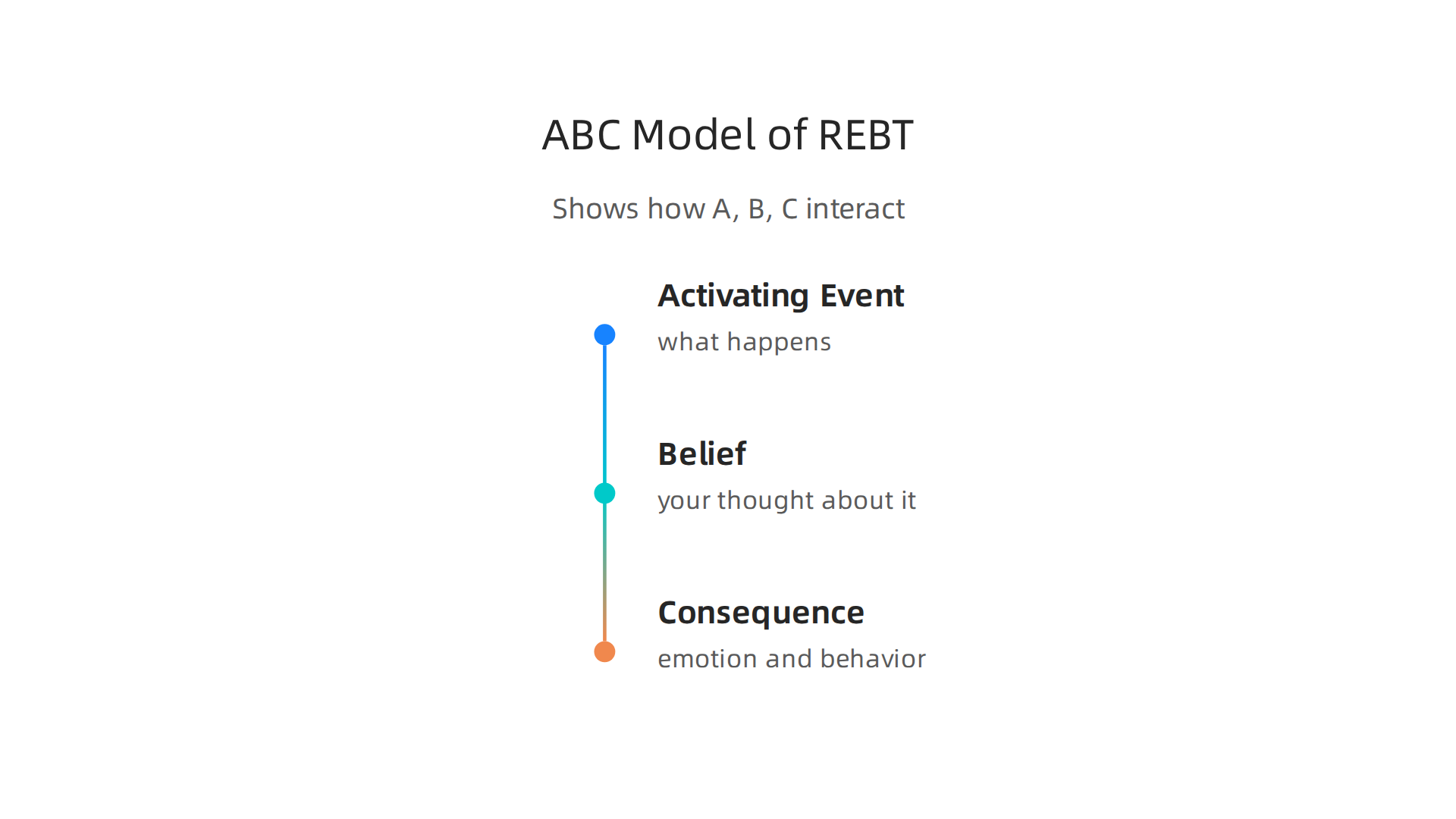
The goal is to see that changing B changes C. This is a powerful tool for coping skills therapy because it gives you a step you can take right away.
In this article, you will learn the core concepts of REBT, the research that backs it up, and practical techniques you can use today to feel calmer. If you want a deeper dive into step by step anxiety management strategies, that guide can help. And for a real world example of how cognitive approaches make a difference, take a look at what Authority Magazine reported about programs that reward healthy behaviors to offset anxiety. Let’s explore how REBT can help you quiet that alarm.
The Origins and Foundations of Rational Emotive Behavior Therapy
Understanding where rational emotive behavior therapy comes from helps you see why it works so well for anxiety.

Albert Ellis created this approach in the mid-1950s, and it changed the direction of modern psychology. Before REBT, most therapists used psychoanalysis, which meant spending years talking about childhood dreams and past conflicts. Ellis thought that process was too slow and not helpful enough.
Ellis started his career as a psychoanalyst but grew frustrated with how passive and long the treatment felt. He believed people needed active methods to feel better now, not years later. According to the detailed history of Albert Ellis and REBT, he broke from psychoanalysis entirely and built something new. He called it rational therapy at first, then rational emotive therapy, and finally rational emotive behavior therapy in 1993.
The foundation of REBT comes from an old idea. Ellis was inspired by ancient Stoic philosophers, especially Epictetus, who said, "Men are disturbed not by things, but by the views which they take of them." This is the core of rational emotive behavior therapy. Your beliefs about what happens, not the event itself, create your anxiety. This was a radical shift in the 1950s.
REBT became the very first cognitive-behavioral therapy. It paved the way for modern CBT and many third-wave therapies that followed. Ellis published his seminal article "Rational psychotherapy and individual psychology" in 1957, and his book "Reason and Emotion in Psychotherapy" in 1962. These works legitimized the idea that changing your thinking can change your emotional pain. If you want to see how these principles apply to a specific type of anxiety, this guide to social anxiety disorder treatment with CBT shows how cognitive approaches rewire fear.
For anyone struggling with therapy insecurity or looking for a coping skills therapy that feels direct and empowering, understanding where REBT came from builds confidence. This approach has been tested and refined for over 70 years. It works because it respects your ability to change your thinking starting today.
The ABC Model: The Core Mechanism of REBT
Now that you know where REBT came from, let’s look at its engine. The ABC model is the heart of rational emotive behavior therapy. It shows you exactly how your thoughts create your anxiety.
The model has three parts. A stands for Activating event. That is the thing that happens to you. Someone criticizes you. You make a mistake. You get a flat tire. B stands for Belief. This is the thought you have about the event. C stands for Consequence. That is the emotion and behavior that follow.
Here is the key insight: Most people think A causes C. But REBT says B is the real cause. Your belief about the event, not the event itself, creates your emotional response. According to this detailed overview of REBT and the ABC model, your interpretation of what happens matters more than what actually happens.
Beliefs fall into two groups. Rational beliefs are flexible and based on evidence. They lead to healthy emotions like disappointment or concern. Irrational beliefs are rigid and extreme. They use words like "must," "should," and "awful." These beliefs lead to unhealthy emotions like panic, rage, or shame. The ABC model works as a coping skills therapy because it helps you spot the irrational belief and change it.
For example, imagine your boss sends you a short email that feels cold. An irrational belief might be: "She must be mad at me. I can’t stand the tension. This is awful." That belief triggers hours of anxiety and overthinking. A rational belief might be: "I prefer clear communication, but short emails don’t always mean anger. I can ask for clarity." That belief leads to a calm follow-up instead of a spiral.
REBT also defines three specific types of irrational beliefs: demandingness, awfulizing, and low frustration tolerance.
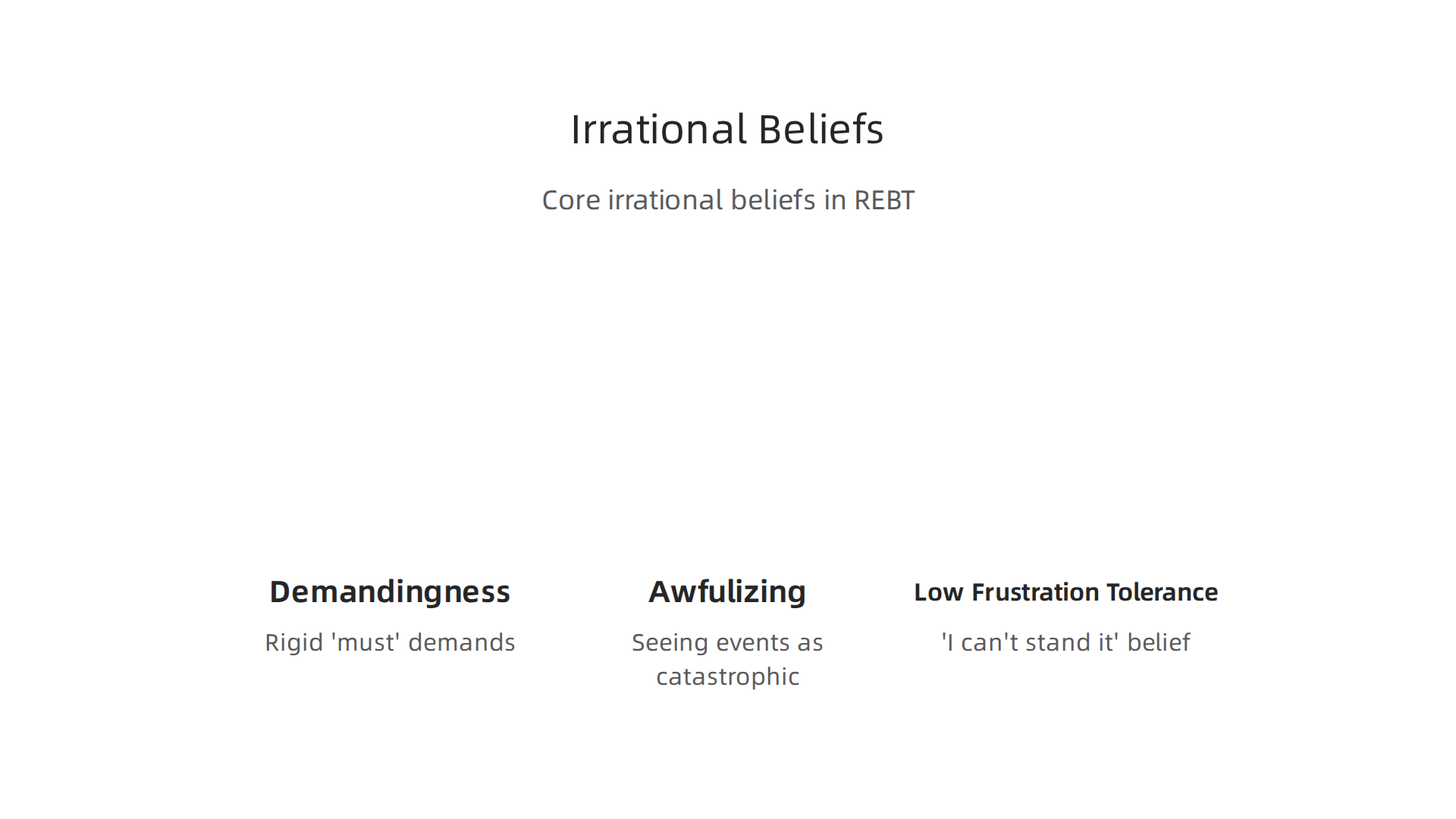
Research on irrational beliefs in REBT explains how rigid demands like "I must succeed" create unhealthy consequences. The goal of REBT is to dispute these rigid thoughts and replace them with flexible, rational ones.
If you want to start catching your own irrational beliefs, try these anxiety management step-by-step strategies. They give you a practical way to apply the ABC model to your real life.
Learning this model can also reduce therapy insecurity. When you understand exactly how anxiety works, you feel more in control. The ABC model turns a scary feeling into a solvable puzzle. For anyone wondering what insecurity therapy actually looks like in practice, this framework provides the answer.
How REBT Directly Addresses Anxious Feelings
You already know that irrational beliefs fuel anxiety. Words like "must," "should," and "awful" turn normal stress into panic. So how do you actually change those thoughts? That is where REBT moves from theory to action.
The ABC model gives you the map. But the real work happens in step D: Disputation. This is the part where you challenge your irrational beliefs head-on. Instead of accepting "I must be perfect," you ask yourself hard questions. Is that belief true? Does it help me? Where is the evidence?
REBT uses three types of arguments to dispute thoughts.
Logical arguments. You check if the belief makes sense. "I must be perfect" does not follow logically because no human can be perfect 100 percent of the time. The demand contradicts reality.
Empirical arguments. You look for real-world proof. "Something terrible will happen if I am not in control" sounds scary. But when you search for evidence, you find that many things go fine without your control. Your fear is not backed by facts.
Pragmatic arguments. You ask whether the belief helps you. "I must be perfect" might push you to work hard, but it also creates crippling anxiety. In the long run, it hurts more than it helps.
These three approaches form the core of how to dispute irrational beliefs effectively. With practice, you learn to spot rigid thoughts and replace them with flexible ones.
The final step is E: Effective New Belief. After disputing, you build a rational alternative. Instead of "I must be perfect," you say, "I prefer to do well, but I can accept mistakes as part of learning." Instead of "Something terrible will happen if I am not in control," you say, "I can handle uncertainty, and I will adapt."
This shift does not happen overnight. REBT is a skill you practice. Every time you catch a "must" or "awful" thought, you dispute it. Over weeks and months, your anxiety loses its power.
For more practical ways to challenge anxious thinking, check out these evidence-based strategies to cope with anxious feelings and build inner strength. They work well alongside REBT practice.
The beauty of rational emotive behavior therapy is that it gives you a clear system. You are not guessing how to feel better. You are applying logic, evidence, and pragmatism to the thoughts that scare you most. And with each dispute, you shrink anxiety one irrational belief at a time.
Evidence and Efficacy: Does REBT Really Work?
That all sounds promising in theory. But does rational emotive behavior therapy actually hold up under scientific scrutiny? The answer is yes, and the research is surprisingly strong.
Dozens of randomized controlled trials and meta-analyses have tested REBT over the past 50 years.

One large systematic review of REBT interventions found medium to large effect sizes across many outcomes. People who used REBT showed significant reductions in irrational beliefs, improvements in mental health, and better emotional functioning compared to control groups. The benefits often lasted long after treatment ended. You can read more in that systematic review of REBT interventions.
Another study looked at medical students dealing with generalized anxiety disorder. Before REBT, their anxiety scores were very high. After the REBT program, scores dropped to a subclinical level. The changes were statistically significant for anxiety, irrational cognitions, and specific beliefs like awfulizing and low frustration tolerance. That study confirms REBT is extremely efficient for improving emotional functioning in a high-stress group.
What makes REBT especially effective? Homework assignments. REBT is not just talk. You practice between sessions. Therapists give you self-help forms and behavioral experiments. You track your irrational beliefs, dispute them, and replace them with rational ones in real life. This consistent practice rewires your thinking over time.
Newer research is expanding where REBT works. Digital REBT programs are being tested for people who cannot access regular therapy. Workplace REBT programs help employees manage stress and improve performance. The core techniques adapt well to these settings, making REBT more accessible than ever before.
There are no affiliate links or CTAs provided, but we can include an internal link to evidence-based strategies.
For a practical roadmap that builds on this evidence, check out these evidence-based techniques for lasting relief. They pair perfectly with the REBT approach you are learning here.
So the short answer is: yes, REBT really works. The science backs it up. And when you add homework and real-world practice, your results get even better. That is not just theory. That is data.
REBT vs. Cognitive Behavioral Therapy: Key Differences
Now that we have seen the strong evidence for rational emotive behavior therapy, you might wonder how it compares to its famous cousin, cognitive behavioral therapy (CBT). Many people use the names interchangeably, but they are not the same. Understanding the differences can help you choose which approach fits your needs.
REBT actually came first. Albert Ellis developed it in the 1950s, and CBT came later from Aaron Beck. Both are proven therapies, but they tackle problems in different ways. The main difference is where they focus.
In CBT, you work with your therapist to identify distorted thoughts, like "I always mess up" or "Nothing goes my way." You use thought records and cognitive restructuring to test those thoughts against reality. The therapist acts as a supportive guide, helping you replace negative thinking with more balanced views. This approach works well for many people.
REBT takes a more philosophical approach. Instead of just questioning whether a thought is true, REBT digs into the rigid beliefs behind it. Your therapist will help you dispute beliefs like "I must be perfect" or "It is awful if things go wrong." The therapy uses a more direct, sometimes confrontational style to help you uproot those absolute demands. As one expert explains, REBT addresses the philosophic basis of emotional disturbance, which makes it especially powerful for people with rigid thinking.
For example, if you tend to think in extremes like "I can’t stand this" or "This is unbearable," REBT is designed for you. It teaches you to replace demandingness with flexible preferences. It also emphasizes unconditional self-acceptance, a concept that goes beyond just raising self-esteem.
Both therapies are excellent, but they serve different personality types. If you like a structured, collaborative approach with lots of practical tools, CBT may feel more comfortable. If you want to challenge the very roots of your anxious thinking and shift your whole philosophy, REBT might be a better fit.
To learn more about how CBT applies to a common anxiety condition, check out this social anxiety disorder treatment with CBT guide. It shows how the broader CBT approach works in practice.
In short, both REBT and CBT can help you feel calmer and more in control. The key is knowing which style matches your thinking patterns and what you are ready to change.
Practical REBT Techniques You Can Use Today
So now you know what REBT is and how it differs from CBT. But let us talk about the actual tools you can start using right away. Rational emotive behavior therapy is not just about talking in a therapist’s office. It gives you hands-on techniques that work in real life.
The Disputing step
This is the heart of REBT. When you catch yourself thinking something like "I must not fail," you learn to challenge that belief. Therapists use three types of arguments to help you do this:
- Logical disputing: Ask yourself, "Does this belief make sense?" For example, does it logically follow that you must be perfect?
- Empirical disputing: Look for real evidence. Is there proof that you are actually a failure if you make one mistake?
- Practical disputing: Check if the belief helps you. Does thinking "I can’t stand this" actually make the situation better?
The goal is to replace rigid demands with flexible preferences. You can learn more about these disputing techniques in REBT therapy from a detailed guide that walks through each step.
Rational Emotive Imagery
This technique is surprisingly simple and powerful. You close your eyes and vividly imagine a worst-case scenario things like losing a job or being rejected. While holding that image, you let yourself feel the upset emotion. Then, without changing the image, you deliberately shift your feeling to a healthier one, like deep disappointment instead of panic. You practice this switch several times. The exercise rewires your brain to handle real stress better. A helpful step-by-step guide for using imagery to dispute irrational beliefs can walk you through it.
Self-help forms
REBT gives you structured sheets to fill out between sessions. The most common one is the REBT Self-Help Report. You write down the triggering event, your irrational belief, and your disputing arguments. You also record your new rational belief. Doing this daily builds your coping skills therapy muscles. The Albert Ellis Institute offers a PDF of DIBS (Disputing Irrational Beliefs) questions that you can use at home.

These techniques turn abstract ideas into real change. The more you practice, the more natural it feels. If you want more ways to apply these concepts, check out this guide on anxiety management step-by-step strategies that reinforce the same principles.
Integrating REBT with Modern Behavioral Technologies
The pen-and-paper techniques and imagery exercises you learned are powerful on their own. But technology can make practicing rational emotive behavior therapy even easier and more consistent. New tools like recognition systems, gamified apps, and behavioral tracking help you apply coping skills therapy throughout your day.
One exciting development is the Value Reinforcement System (VRS), U.S. Patent No. 12,205,176, co-invented by Dean Grey. VRS is a recognition framework that reinforces rational choices the moment you make them. Think of it as a digital coach that gives you a small reward whenever you pick a healthier thought over an irrational one. This aligns perfectly with REBT’s core goal of replacing rigid demands with flexible preferences.
Gamified platforms also fit well with REBT. Apps that use points, badges, and progress charts make the practice of disputing irrational beliefs feel more like a game than homework. The Albert Ellis Institute has a research overview of REBT-based apps and games currently in development. Early trials are testing REBT games for depression, social anxiety, and emotional resilience in children. Gamification keeps you engaged long enough for new thinking patterns to stick.
Behavioral tracking takes the guesswork out of therapy insecurity. By logging your mood, triggers, and thoughts, you start to see clear patterns. You can measure how often your irrational beliefs pop up and how well your disputing skills are working. This data-driven approach turns insecurity therapy into something you can track and improve over time. Pairing REBT with a tool like sleep tracking apps for anxiety can even reveal how your sleep habits affect your emotional state.

Together, these technologies offer scalable support for anxiety management. You get real-time feedback, ongoing motivation, and hard data on your progress. That makes REBT more practical and accessible than ever.
Conclusion: Building a Rational Mindset for Lasting Calm
Rational emotive behavior therapy is not a passing trend. It is a well-researched, proven framework that has helped people manage anxiety for decades. Albert Ellis developed REBT in the 1950s, and today it remains one of the most effective forms of cognitive behavioral therapy. According to the overview of REBT in the context of modern research, the method focuses on identifying and changing irrational beliefs that cause emotional distress. This solid foundation gives you a reliable path to lasting calm.
The real power comes from mastering the ABC model: Activating event, Beliefs, and Consequences. By learning to dispute your irrational beliefs, you can reduce the intensity of anxious feelings and regain control. This skill, often called coping skills therapy, puts you back in the driver’s seat. If you have ever felt therapy insecurity wondering if REBT really works, the evidence says yes. Every time you catch a rigid "must" or "should" thought and replace it with a flexible preference, you weaken anxiety’s hold.
Modern tools like the Value Reinforcement System make this practice even easier. VRS rewards you when you choose a rational thought over an irrational one. That reinforcement helps your new thinking patterns become automatic. To see how this works in real-world settings, check out the Youth Safety Case Study, which documents how VRS helps athletes build resilience and resist negative influences.
You now have a complete system for building a rational mindset. REBT gives you the framework, daily practice builds the skill, and modern technology provides ongoing support. If you are ready for more step-by-step help, explore these anxiety management step-by-step strategies that work hand in hand with your REBT practice. Start today and watch your calm grow stronger with each rational choice.
Summary
Rational Emotive Behavior Therapy (REBT) is a structured cognitive-behavioral approach that teaches you how your beliefs—not events—create anxiety, and how changing those beliefs reduces emotional pain. This article explains REBT’s origins with Albert Ellis, the central ABC model (Activating event, Belief, Consequence), and the critical Disputation step that replaces rigid